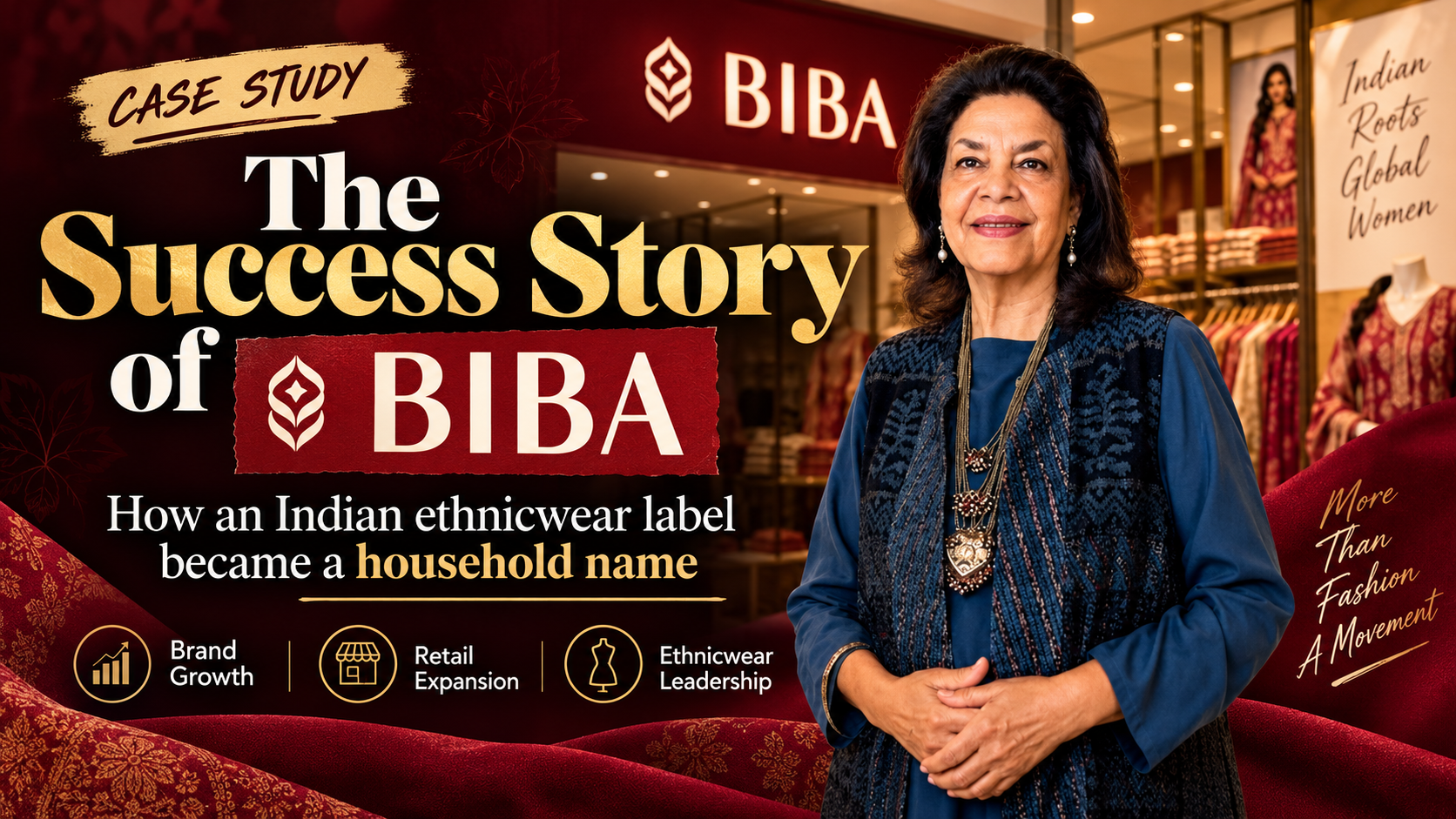
BIBA is one of the clearest Indian ethnicwear examples of how a small, product-led business can evolve through several distribution models before becoming a large branded retail company.
Founder Meena Bindra’s story is especially relevant to wholesale buyers because BIBA did not begin with an expensive store network. Public interviews describe a much more gradual path: home-based production, direct selling, wholesale supply, department-store distribution and eventually dedicated branded retail.
Case study snapshot
| Brand | BIBA |
|---|---|
| Founder | Meena Bindra |
| Category | Indian ethnicwear |
| Early model | Home-based clothing business and wholesale supply |
| Growth model | Wholesale → department stores → branded retail |
| Strategic lesson | Distribution can evolve in stages as product-market fit strengthens |
The beginning: start with a product customers already understand
BIBA’s early product category was not exotic. Salwar-kameez was already part of everyday Indian wardrobes. The opportunity was to make that familiar category more organised, accessible and brandable.
This is a valuable principle for Chikankari too. A business does not always need to invent a new category. It can win by improving how an existing category is designed, supplied and presented.
Lesson 1: wholesale can be a growth engine, not a compromise
Many founders treat wholesale as less glamorous than direct-to-consumer retail. BIBA’s history shows why that view is too narrow.
Wholesale distribution can help a young brand:
- reach customers without opening stores,
- test product acceptance across markets,
- build production volume,
- generate cash flow,
- learn which styles repeat.
For Chikankari brands, this makes boutiques and multi-brand retailers valuable market-testing partners rather than simply sales channels.
Lesson 2: move to owned retail when the economics and brand justify it
Opening dedicated stores creates control over presentation, assortment and customer experience, but it also creates fixed costs.
BIBA’s progression suggests a sensible sequence: build demand first, then increase channel control.
Emerging brands should therefore avoid copying the final stage of a mature company before earning the earlier stages.
Lesson 3: standardisation helps traditional categories scale
Ethnicwear can be difficult to scale when sizing, fabrics and product specifications vary too much.
A national brand needs stronger systems around:
- size consistency,
- repeatable fits,
- quality control,
- merchandising,
- inventory planning,
- seasonal assortment.
This is equally important in Chikankari. Craft variation can remain authentic while garment measurements, construction and commercial information become more disciplined.
See our Chikankari size-planning guide for the buyer side of that problem.
Lesson 4: brand building changes price comparison
A branded retailer competes differently from an unbranded supplier.
Customers begin to value:
- trust,
- fit consistency,
- store experience,
- design language,
- availability,
- after-sales support.
That reduces the importance of comparing products only by fabric and stitching cost.
Lesson 5: category depth can be more powerful than category breadth
BIBA became strongly associated with women’s Indian wear before extending the proposition. This created mental availability: customers knew what the brand stood for.
For Chikankari businesses, the comparable lesson is to become trusted for the craft before expanding into unrelated fashion.
What wholesalers can learn from BIBA
- Wholesale can validate demand before owned retail.
- Build systems as volume grows.
- Standardise what should be standardised.
- Use brand trust to reduce pure price competition.
- Expand channels in stages rather than all at once.
What boutiques can learn
Retailers should look for suppliers whose products can support repeat selling rather than one-off novelty. That means checking size consistency, reorder potential, product information and quality control.
Our Chikankari reorder strategy helps boutiques evaluate those signals after launch.
Why this matters for ChikankariWholesale.com
BIBA’s journey demonstrates how wholesale can sit at the centre of a long-term brand-building model. For emerging Chikankari labels, boutiques and ecommerce sellers, the first objective is not to imitate a national chain. It is to build a product range customers buy again.
Start with the wholesale catalogue, choose a focused assortment and use the quote request to discuss quantity, sizes and destination.
Sources and methodology
This article draws on public interviews with Meena Bindra, including Forbes India’s profile of the BIBA founder. Business lessons are interpretive analysis of the documented growth journey.