Most craft brands do not begin with a perfect business plan. They begin with a hunch: that something culturally valuable also has commercial potential if it is presented to the right customer in the right way.
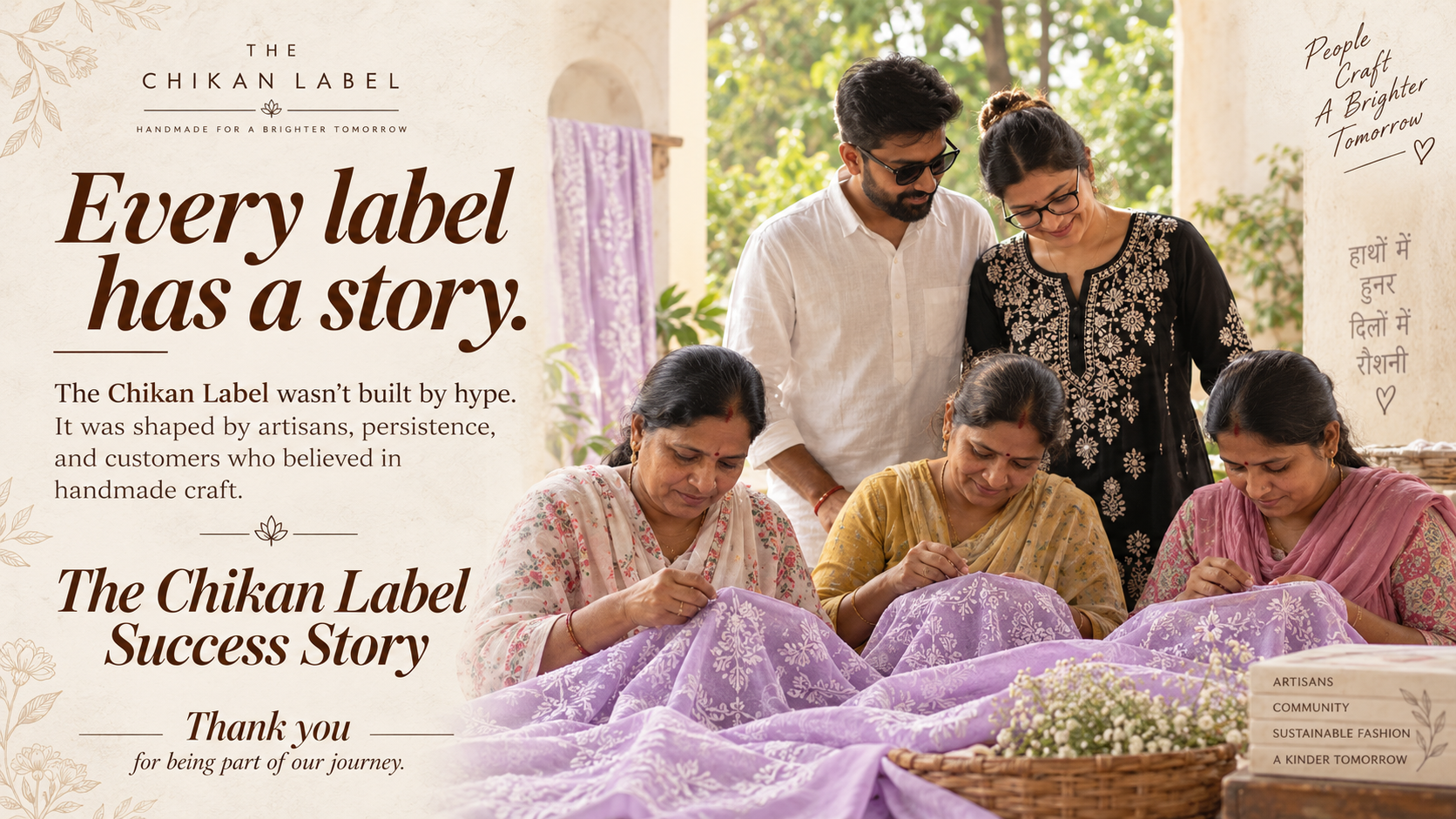
The Chikan Label is a useful example because its story combines several themes that matter to anyone building a Chikankari business today: recognising demand before scaling, building around a specific craft, using digital channels early, staying close to production, and turning provenance into part of the product rather than treating it as decoration.
This case study is based on The Chikan Label’s own website and public founder accounts. Where numbers or milestones come from those first-party sources, they should be read as brand-stated information rather than independent third-party verification.
Case study snapshot
| Brand | The Chikan Label |
|---|---|
| Base | Lucknow, Uttar Pradesh |
| Founded | 2018, according to the brand |
| Founders | Komal Shukla and Hardik Deol |
| Core category | Lucknowi Chikankari apparel |
| Early growth signal | Online demand for Chikankari before the formal brand launch |
| Strategic lesson | Validate demand, own a clear craft niche, and make digital distribution part of the business model from the beginning |
The first lesson: demand can be visible before a brand exists
In a public founder post, Hardik Deol describes listing a Chikankari anarkali on eBay in 2017 and seeing it sell repeatedly. His account is valuable because it shows a basic entrepreneurial principle that is easy to overlook: a small real transaction can teach more than a large amount of speculation.
Instead of beginning with a large collection, expensive branding exercise or retail store, that early online sale provided evidence that customers outside the immediate Lucknow market were already searching for the craft.
That is particularly relevant for heritage products. Demand may exist long before the category is well organised online. The business opportunity is sometimes not to invent demand, but to make existing demand easier to trust, understand and buy.
For boutiques and resellers, the same principle applies. Before committing heavily to a new Chikankari category, test a small, representative assortment and measure actual response. Our guide on testing a Chikankari collection with lower inventory risk explains how to structure that process.
The second lesson: location can become an operating advantage
The Chikan Label was built in Lucknow, the city most strongly associated with Chikankari. That matters for more than storytelling.
A craft business located close to its production ecosystem can potentially learn faster. Product development, fabric sourcing, embroidery discussion, sampling, finishing and quality feedback can all benefit when the people making buying decisions are physically close to the craft network.
But location is only an advantage when the business uses it. Simply writing “Lucknow” on a website does not create differentiation. The stronger advantage comes from understanding what buyers cannot easily see online: stitch quality, fabric behaviour, embroidery density, variation between pieces, finishing, sizing and the practical limits of repeatability.
That is why serious B2B buyers should evaluate more than catalogue photographs. A Chikankari manufacturer in Lucknow should be able to discuss the actual product specification, not only location.
The third lesson: a craft brand still needs a modern commercial engine
The brand’s public founder profiles show that digital marketing experience was part of the founding mix. This is important because craftsmanship alone does not solve discovery.
A traditional product can be excellent and still remain commercially invisible if:
- the customer cannot find it online,
- the product photography does not explain the embroidery,
- sizing is unclear,
- the brand does not answer basic trust questions,
- international buyers cannot understand shipping or product details,
- the story is communicated as nostalgia without a strong buying proposition.
The Chikan Label’s model demonstrates the value of connecting an old craft with newer distribution tools rather than treating those two worlds as opposites.
The fourth lesson: product storytelling works best when it explains value
Craft brands often make one of two mistakes. Some say almost nothing about the work. Others tell such a romantic story that the buyer still does not understand the product.
The more commercially useful approach sits between them.
A Chikankari customer may want to know:
- Is the embroidery hand worked or machine produced?
- Which fabric is being used?
- How dense is the work?
- Is the back plain or worked?
- What makes this piece different from a lower-priced alternative?
- How should the customer choose a size?
When storytelling answers those questions, it supports both trust and conversion. It gives the customer a reason to value the product rather than relying on vague language about heritage.
Wholesale buyers can apply the same principle to their own product pages. See how to photograph and list Chikankari online for a practical ecommerce framework.
The fifth lesson: the founder story should support the business, not replace it
Founders are powerful trust builders, particularly in craft-led companies. Customers want to know who is behind the product and why the business exists.
But a founder story is not a substitute for operational reliability.
As a brand grows, buyers eventually judge it on repeatable fundamentals:
- product consistency,
- stock accuracy,
- dispatch discipline,
- customer communication,
- size consistency,
- quality control,
- reorder reliability.
The useful lesson from The Chikan Label story is therefore not “tell your story and growth will follow.” It is that story can open the door, but systems keep the customer.
The sixth lesson: Chikankari can be positioned as a category, not just a motif
A strong specialist brand benefits from being known for one thing before trying to be known for everything.
Chikankari is broad enough to support a complete retail proposition. Within the same craft umbrella, a brand can develop:
- everyday kurtis,
- kurta sets,
- occasion pieces,
- sarees,
- co-ords,
- short tops,
- white collections,
- premium or embellished ranges.
This creates room for category depth without abandoning the core identity.
For a retailer, the lesson is useful: instead of buying random “ethnicwear”, a narrower, recognisable category can produce clearer merchandising and stronger customer memory. Our Chikankari product-mix planning guide shows how to balance breadth and depth.
The seventh lesson: international demand requires more than a global-looking website
The brand’s public material positions international customers as part of its audience. Founder commentary also discusses the operational learning involved in overseas selling.
That is an important distinction. International growth is not merely accepting foreign cards or adding a currency selector.
A craft business selling abroad has to become competent in:
- product measurements,
- international size communication,
- shipping documentation,
- HS classification,
- customs expectations,
- packaging,
- returns economics,
- delivery communication.
For wholesale importers, these questions should be addressed before a larger order. The international Chikankari wholesale guide covers this buyer-side planning.
What emerging Chikankari brands can learn
The most transferable lessons are not the brand’s exact products or social-media style. They are the underlying decisions.
1. Validate demand with real transactions
A small sale, enquiry or reorder is evidence. Use it to guide the next step.
2. Build around a clear point of expertise
Being known for authentic Lucknow Chikankari creates more memory than presenting a generic mix of unrelated fashion products.
3. Combine craft knowledge with distribution skill
A heritage product still needs strong ecommerce, photography, customer service and digital acquisition.
4. Stay close to the product
As demand grows, maintaining quality becomes harder, not easier. Production knowledge is a strategic asset.
5. Make provenance useful
Origin and artisan stories matter more when they help customers understand what makes the garment different.
What wholesalers and boutiques should not copy blindly
Case studies are useful only when the reader understands context.
A retailer should not conclude that:
- every Chikankari brand needs the same founder-led positioning,
- every product should be hand embroidered regardless of customer price point,
- international ecommerce is automatically profitable,
- a large range is better than a focused range,
- social followers prove product-market fit.
Use the principles, not the surface details.
Why this case matters for the wholesale market
The broader lesson is that Chikankari is no longer limited to tourists buying from a Lucknow market or customers purchasing an occasional white kurta. Digital brands have helped make the craft searchable, explainable and sellable to customers who may never visit Lucknow.
That changes the opportunity for wholesalers too. B2B buyers now need suppliers who understand not only production, but also how the product will be sold online, photographed, sized, packed and reordered.
If you are building a Chikankari range for a boutique, ecommerce store or private label, start with the wholesale catalogue and send a structured requirement through the wholesale quote request.
Sources and methodology
This article draws primarily on first-party information from The Chikan Label’s About page and public founder commentary from Hardik Deol’s LinkedIn profile. Brand-stated milestones are presented as such and are not treated as independently audited figures.