Authentic Lucknow Chikankari | Wholesale | Manufacturing | Private Label SHOP NOW

Authentic Lucknow Chikankari | Wholesale | Manufacturing | Private Label SHOP NOW
EXPORT OPERATIONS FOR INTERNATIONAL B2B ORDERS
Export Documentation & Customs for Chikankari Orders
A practical B2B guide for importers, boutiques, distributors, fashion brands and sourcing teams buying Chikankari from India. Understand the documents, customs data, buyer inputs and shipment decisions that should be aligned before an international order leaves India.
Export documentation is transaction-specific. The exact documents, tariff treatment, taxes, certificates and destination requirements depend on the product, shipment mode, importing country and agreed commercial terms.

What an International Buyer Should Align Before Dispatch
The shipment should connect the physical goods, commercial order and customs data. These four areas need to agree.
Product Data
Accurate product description, quantity, fibre/material information where verified, size/colour breakdown and country of origin.
Commercial Data
Buyer/consignee details, invoice value, currency, payment terms and agreed commercial/shipping terms.
Customs Data
HS/tariff classification, origin, customs value and any destination-specific information required for clearance.
Logistics Data
Package count, weights, dimensions, shipping mode, consignee, destination and courier/freight-forwarder requirements.
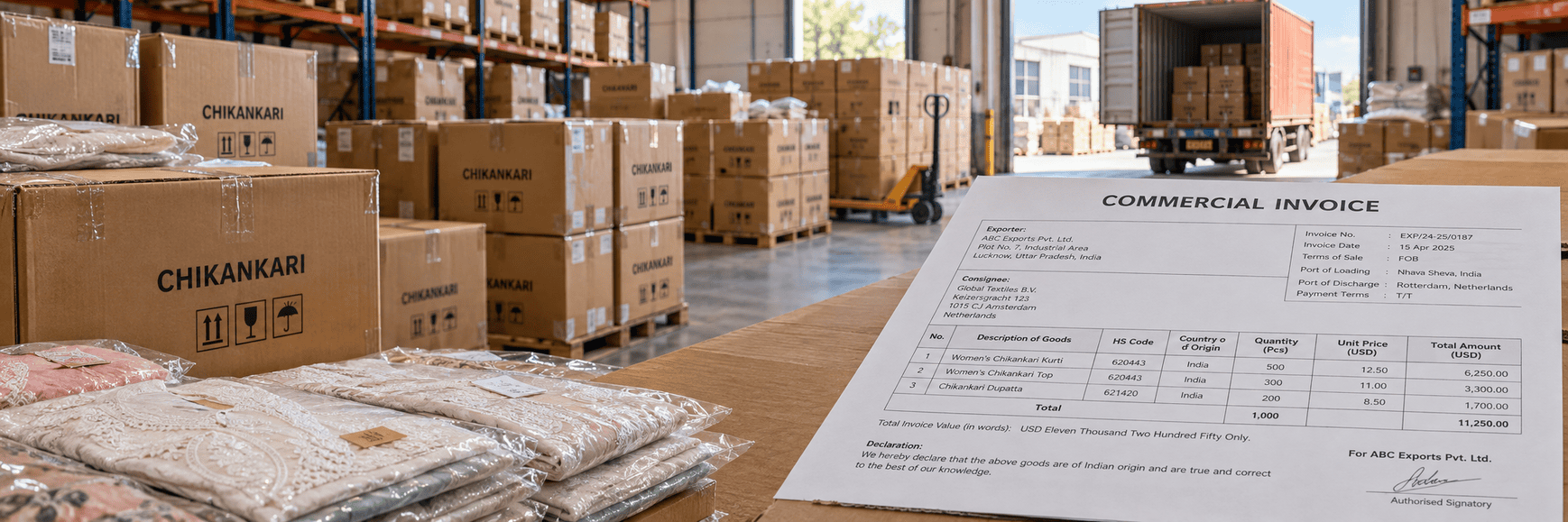
01. Commercial Invoice: The Shipment’s Core Commercial Record
The export invoice should describe the actual transaction clearly enough for the buyer, logistics provider and customs process to understand what is being shipped.
Depending on the transaction, relevant invoice information can include exporter and buyer/consignee details, invoice number/date, product description, quantity, unit value, total value, currency, country of destination, country of origin and agreed shipping/commercial terms.
Under India’s GST invoice rules, export invoices require the appropriate export endorsement depending on whether export is under LUT/bond without IGST payment or on payment of IGST. The invoice also carries destination-related details specified by the rules.
Important: the invoice description should match the actual goods. Avoid vague wording such as only “clothes” or only “Chikankari” where the transaction needs a more specific garment/textile description.
02. Packing List: Make the Physical Shipment Easy to Reconcile
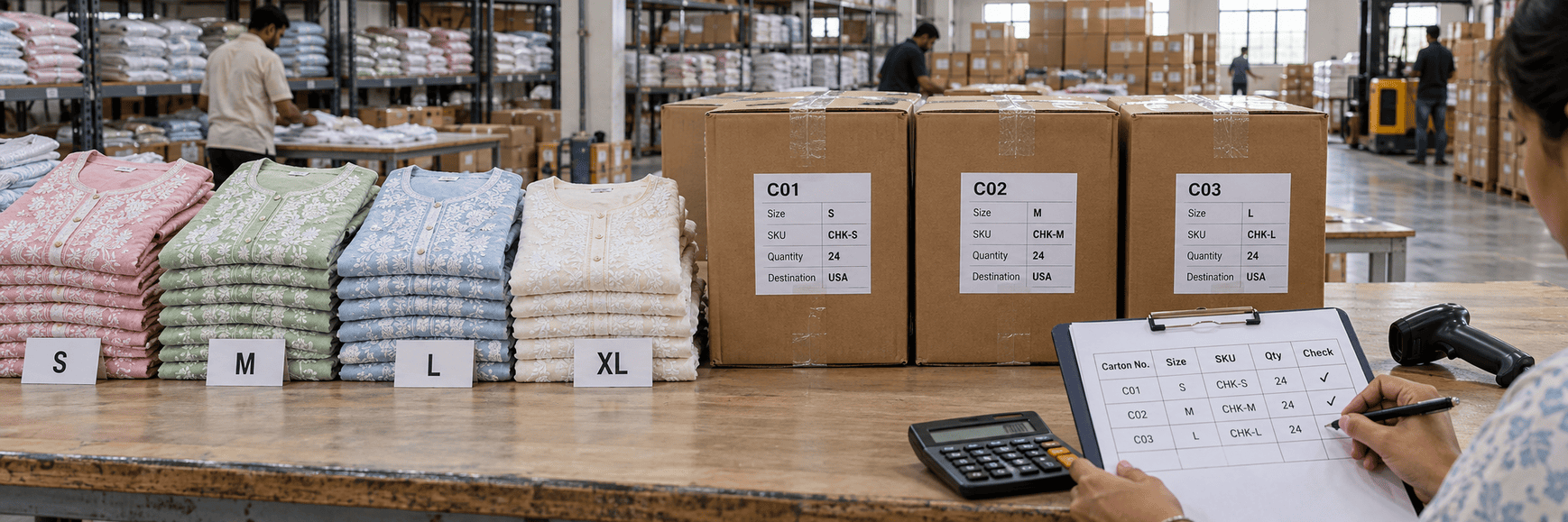
A packing list is operationally useful because it connects the invoice to the physical packages. It can record carton or package numbers, SKU/style references, size and colour quantities, pieces per package, gross/net weight and dimensions where relevant.
For Chikankari orders with many styles and sizes, a detailed packing structure reduces confusion for the buyer’s warehouse and can help customs/logistics teams reconcile quantities.
If the buyer requires barcode labels, carton marks, size-ratio packing, PO references or warehouse-specific labels, share those requirements before packing starts. These are buyer/project-specific and should not be assumed to be included automatically.
03. Shipping Bill: Indian Customs Export Filing
For goods exported from India, the Shipping Bill is the principal customs export declaration. ICEGATE documentation identifies the Shipping Bill as the exporter/Customs filing message submitted into the Indian Customs EDI system.
The customs filing must reflect the actual shipment data, including the goods description, tariff classification, value and other required declarations. The exporter, customs broker or authorised filing party should validate the final information before submission.
Chikankari itself is an embroidery/craft description—not a universal customs classification. The applicable HS/ITC(HS)/destination tariff code can depend on whether the shipment is a kurta, dress, shirt, saree, fabric, set or another textile product, as well as fibre composition and construction. Do not use one tariff code for every Chikankari product without classification review.
Documents That May Be Part of an Export File
Not every shipment needs every document. Build the file around the actual transaction and destination.
Core Commercial Records
- commercial invoice
- packing list
- purchase order / order confirmation where used
- payment or bank-related records as applicable
Customs & Transport Records
- shipping bill / customs export declaration
- air waybill or bill of lading / courier transport record
- freight-forwarder or courier paperwork
- insurance record where applicable
Conditional / Destination Documents
- certificate of origin where required or commercially useful
- preferential origin evidence where a trade agreement applies
- buyer-requested declarations
- destination-specific textile/compliance records where applicable
04. Certificate of Origin: Use It When the Transaction Requires It
A Certificate of Origin (CoO) provides formal origin information for goods. It is not automatically the same thing as proof that a shipment qualifies for a lower tariff.
When a preferential trade agreement applies, the importer may need the prescribed origin evidence and the goods must satisfy that agreement’s rules of origin. DGFT operates electronic systems for preferential and non-preferential Certificates of Origin, with preferential applications routed through the current eCoO framework.
For Chikankari garments, do not promise preferential duty merely because the goods are shipped from India. Eligibility depends on the specific agreement, tariff line, origin rule and supporting evidence.

05. GST Treatment of Exports from India
Under India’s IGST framework, exports are treated as zero-rated supplies. The law provides routes for export under bond/Letter of Undertaking without payment of integrated tax, with refund of eligible unutilised input tax credit, or export on payment of integrated tax with refund subject to the applicable conditions and procedure.
The exact GST route is an exporter-side tax/compliance decision and should be handled against the actual entity, invoice and return position. International buyers should not treat zero-rating as meaning that destination import taxes or duties disappear—the importing country applies its own customs and tax rules.
Destination Customs: The Importer Must Validate the Local Rules
Export clearance in India and import clearance in the destination country are separate processes. The overseas importer should confirm the local tariff classification, duty, VAT/GST/sales tax, importer registration, textile labelling and any product-specific compliance requirements before the order is shipped.
Do not assume that a duty rate used for one country, one garment or one fibre applies to another. A cotton kurta, synthetic dress, saree, fabric length and multi-piece set may classify differently.
If a courier or freight forwarder gives an estimated landed charge, clarify whether that estimate includes duties, taxes, brokerage, disbursement fees and final-mile charges.
Who Is Responsible for What?
Exporter / Supplier Side
- prepare accurate commercial shipment information
- coordinate export-side customs filing through the applicable process
- prepare/coordinate agreed packing and shipping records
- provide transaction documents that are actually agreed and applicable
- keep product description, quantities and values consistent across records
Exact document support is confirmed for each specific order and destination.
Importer / Buyer Side
- provide correct consignee/importer details
- confirm destination import registration where required
- validate local HS/tariff classification and landed taxes
- share mandatory label, compliance or warehouse instructions before production/packing
- arrange destination clearance where the agreed commercial terms place it on the buyer
Export Order Documentation Checklist
- Buyer details: legal/business name, address, contact and consignee/importer information
- Destination: country, city/postcode and final delivery address
- Product data: SKU/style, accurate description, quantities, sizes, colours and verified material details
- Classification: product-specific HS/ITC(HS) and destination tariff review
- Commercials: invoice value, currency, payment and agreed shipping/commercial terms
- Packing: package count, carton marks, SKU/size ratios, gross/net weight and dimensions where required
- Customs filing: exporter-side Shipping Bill/customs declaration data
- Origin: determine whether a CoO or preferential-origin document is actually needed
- Destination compliance: importer confirms duty/tax, labels, registrations and local product rules
- Transport: courier/freight mode and transport-document details
Export Documentation & Customs FAQs
A typical commercial export file may include a commercial invoice, packing list, Shipping Bill/customs export declaration and transport document. A Certificate of Origin or other records may be required depending on the destination, trade agreement, buyer or transaction. Exact documentation is shipment-specific.
No. Chikankari describes the embroidery/craft, not one universal customs product. Classification can differ by garment or textile type, fibre composition, construction and other tariff rules. Validate the actual product classification.
The importing country applies its tariff and tax rules. The importer or its customs broker should validate the classification, origin treatment, customs value, duty and import taxes for the actual shipment.
The Shipping Bill is the principal customs export declaration for goods exported from India and is filed into the Indian Customs system through the applicable exporter/customs-broker process.
Not necessarily. It can be required by the destination, buyer, bank or trade-agreement process, or used for other commercial reasons. Confirm the requirement for the actual shipment.
No. Preferential tariff treatment depends on the relevant trade agreement, tariff line, rules of origin and prescribed origin evidence. Shipping from India alone does not guarantee preferential duty.
Exports are treated as zero-rated supplies under the IGST framework. Exporters may use the legally available LUT/bond or IGST-payment/refund routes subject to the applicable conditions and procedure. This is separate from destination import duties and taxes.
An exact destination duty should be validated against the product classification, origin, customs value and current destination rules. The importer or customs broker is best placed to confirm the final landed treatment.
Provide the correct buyer/consignee/importer details, destination, any local registration numbers where required, label/compliance instructions, warehouse packing requirements and any document requested by your customs broker, bank or logistics provider.
A more specific and accurate product description is generally preferable because Chikankari alone does not identify the type of garment or textile. The description should reflect the actual goods being exported.
The invoice is the commercial transaction record, while the packing list is focused on how the goods are physically packed and distributed across packages. They should reconcile on quantities and shipment references.
That depends on the agreed commercial/shipping terms and destination process. The buyer and seller should clarify responsibility before shipment rather than assuming duties are included in the freight quote.
Where the destination has mandatory textile, fibre, origin, care or language rules, the buyer should communicate those requirements before bulk production or packing. Destination rules vary by market.
Share destination country, buyer/importer details, product categories, approximate quantity, proposed shipping mode and any customs, bank, label, certificate or warehouse requirements already provided by your broker or logistics partner.