Authentic Lucknow Chikankari | Wholesale | Manufacturing | Private Label SHOP NOW

Authentic Lucknow Chikankari | Wholesale | Manufacturing | Private Label SHOP NOW
B2B SIZE & FIT GUIDE
Chikankari Sizing & Measurement Guide for Wholesale Buyers
For wholesale and international buying, the size label alone is not enough. A dependable Chikankari order should be built around actual garment measurements, intended body measurements and the amount of ease required for the fit.
This guide uses the Indian garment measurements supplied in the reference size chart as the base framework, then adds practical fit guidance and an approximate US/UK conversion for international buyers.
First: Body Size and Garment Size Are Not the Same
This is the most important sizing distinction for a wholesale buyer. International charts usually describe the body the garment is intended to fit, while many Indian ethnicwear charts publish the finished garment measurement. Comparing those numbers without accounting for ease can produce the wrong size conversion.
Body Measurement
The wearer’s actual bust, waist and hip measurements taken close to the body. International size charts are commonly based on these measurements.
Garment Measurement
The measurement of the finished kurta, top or set. This is normally larger than the wearer’s body because the garment needs room for movement and the intended silhouette.
Ease
The extra space between the body and garment. The reference guide recommends about 2 inches of ease for a fitted look and about 4 inches for a relaxed Chikankari fit.
Indian Chikankari Garment Size Chart — XS to 7XL
The chart below uses the garment measurements from the supplied Chikankari reference. Measurements are in inches; centimetres are rounded for international readability. Treat this as the reference sizing framework for this guide. For any bulk or private-label order, the approved product measurement sheet should remain the final specification.
| India Size | Garment Bust | Garment Waist | Garment Hip | Bust cm | Waist cm | Hip cm |
|---|---|---|---|---|---|---|
| XS | 34 | 32 | 36 | 86 | 81 | 91 |
| S | 36 | 34 | 38 | 91 | 86 | 97 |
| M | 38 | 36 | 40 | 97 | 91 | 102 |
| L | 40 | 38 | 42 | 102 | 97 | 107 |
| XL | 42 | 40 | 44 | 107 | 102 | 112 |
| 2XL | 44 | 42 | 46 | 112 | 107 | 117 |
| 3XL | 46 | 44 | 48 | 117 | 112 | 122 |
| 4XL | 48 | 46 | 50 | 122 | 117 | 127 |
| 5XL | 50 | 48 | 52 | 127 | 122 | 132 |
| 6XL | 52 | 50 | 54 | 132 | 127 | 137 |
| 7XL | 54 | 52 | 56 | 137 | 132 | 142 |
Important: these are garment measurements, not body measurements.
How to Choose Fitted vs Relaxed Chikankari Sizing
The supplied reference recommends choosing a garment approximately 2 inches larger than the body bust for a fitted look and approximately 4 inches larger for a relaxed fit. For Chikankari kurtas and similar silhouettes, the relaxed option is often the more practical starting point because it allows movement and preserves the intended fall of the garment.
Fitted Look — About 2 in Ease
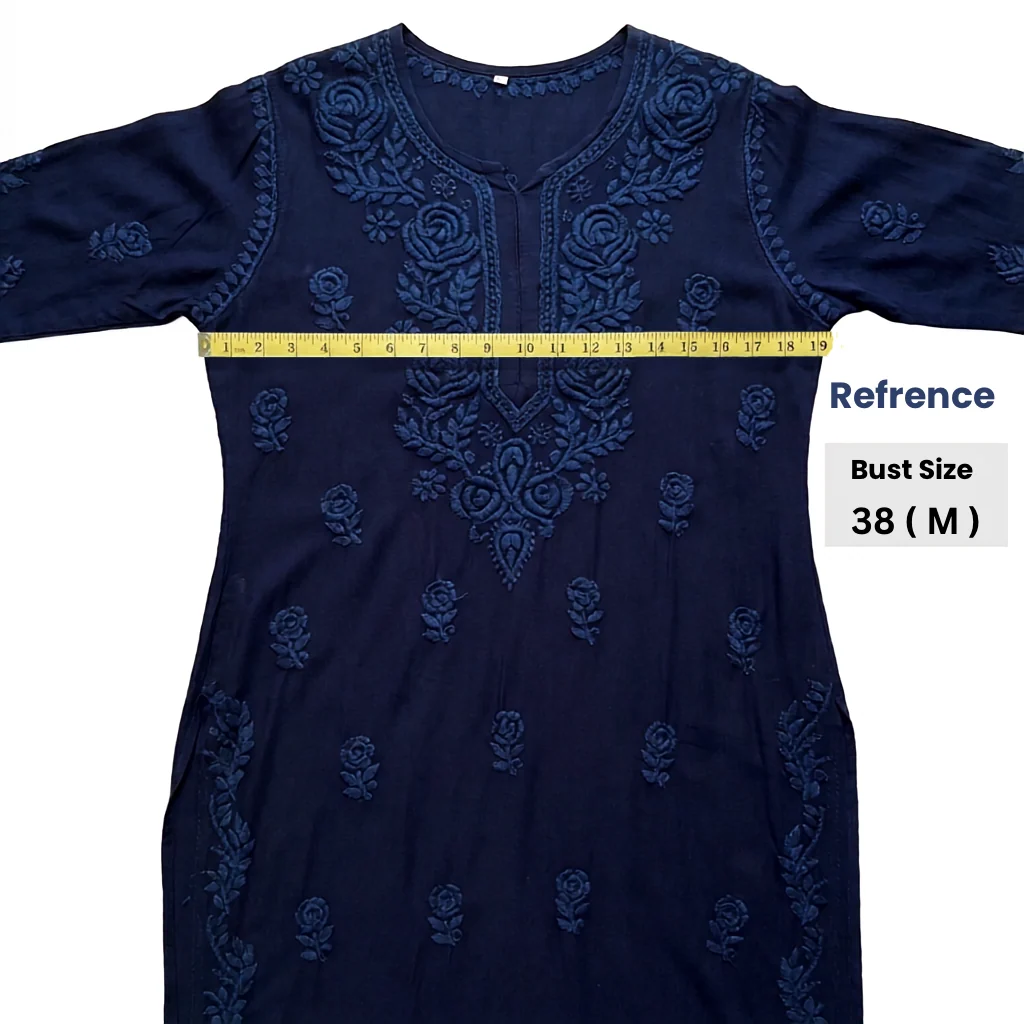
If the body bust is 36 inches, a garment bust around 38 inches gives a closer fit. This corresponds to the M garment measurement in the reference chart.
Relaxed Fit — About 4 in Ease
If the body bust is 36 inches, a garment bust around 40 inches gives a more relaxed fit. This corresponds to the L garment measurement in the reference chart.
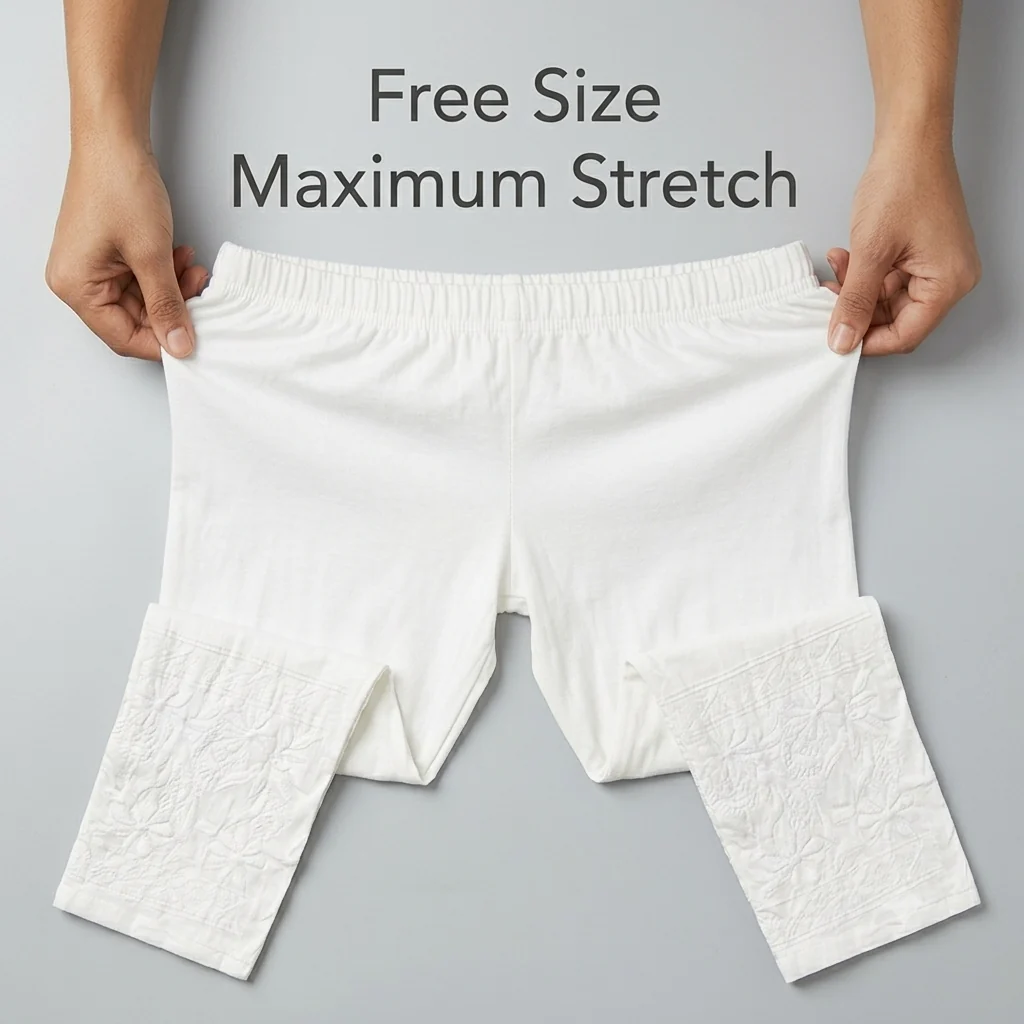
For tops and kurtis: use bust as the primary starting measurement. For bottoms: waist and hip become more important. If a customer carries more volume at the waist or hip than the bust suggests, size to the largest relevant measurement rather than forcing the smaller label.
Approximate India to US & UK Size Conversion
This conversion is designed for international wholesale planning, not as a universal retail standard. It uses the 4-inch relaxed-fit ease from the Indian garment chart to estimate the wearer’s body bust, then aligns that body bust with common US/UK womenswear sizing ranges.
| India Label | Garment Bust | Approx. Body Bust for Relaxed Fit | Approx. US / Canada | Approx. UK |
|---|---|---|---|---|
| XS | 34 in | 30 in | 2 | 6 |
| S | 36 in | 32 in | 4 | 8 |
| M | 38 in | 34 in | 6 | 10 |
| L | 40 in | 36 in | 8 | 12 |
| XL | 42 in | 38 in | 10 | 14 |
| 2XL | 44 in | 40 in | 12 | 16 |
| 3XL | 46 in | 42 in | 14 | 18 |
| 4XL | 48 in | 44 in | 16 | 20 |
| 5XL | 50 in | 46 in | 18 | 22 |
| 6XL | 52 in | 48 in | 18–20 | 22–24 |
| 7XL | 54 in | 50 in | 20+ | 24+ |
Why this is approximate: US and UK brands do not use one legally fixed apparel size standard, and fit blocks differ by brand, category and customer. For a wholesale or private-label order, use this table only for market orientation; approve the final garment measurement chart before production.
Fitted-fit note: if you use only 2 inches of ease instead of 4, the same garment can fit a larger body measurement and its international body-size equivalent may shift upward.
How to Take the Measurements Correctly
Bust
Measure around the fullest part of the chest with the tape level and comfortably close to the body. Do not add ease to the body measurement itself.
Waist
Measure around the natural waistline without pulling the tape tight. For bottoms and fitted sets, this measurement should be reviewed together with the hip.
Hip
Measure around the fullest part of the hips while standing naturally. For straight kurtas, dresses and bottoms, hip room can affect the fit even when the bust size is correct.
Garment measurements: measure a finished sample consistently and record bust/chest, waist, hip, shoulder, sleeve length, armhole, bicep, garment length and relevant bottom measurements. Shoulder, sleeve and length should be style-specific rather than assumed from one universal size table.
What Wholesale Buyers Should Lock Before Bulk Production
- Define whether the chart is body or garment measurement. Never use the same table for both without explanation.
- Approve the base size first. Confirm one sample size before applying grading to the complete range.
- Lock ease by silhouette. A straight kurta, oversized shirt, fitted top and co-ord set should not automatically share the same ease.
- Approve size grading. Confirm how bust, waist, hip, shoulder, armhole, bicep, sleeve and length change between sizes.
- Test the actual fabric. Cotton, rayon, modal, muslin, Chanderi and other fabrics can change the way the same measurements feel and fall.
- Confirm tolerance. Handmade and stitched garments need a defined acceptable measurement tolerance rather than expecting mathematical perfection.
- Check the complete set. For kurta sets and suit sets, approve top and bottom measurements together.
- Use a production measurement sheet. The final approved measurement chart should travel with sampling, QC and repeat orders.
Sizing for US, UK and Other International Markets
For international buyers, the safest approach is to separate the market-facing label from the production measurement specification. A product may be sold as US 8, UK 12 or India L, but production should still be controlled by the approved garment measurements behind that label.
For private-label development, buyers can generally work in one of three ways:
- Use the Indian garment block and publish a clear conversion guide for customers.
- Relabel the same approved garment measurements for the target market after fit testing.
- Provide a buyer-specific US/UK size chart or tech pack and develop samples to that specification before bulk production.
For serious international scaling, option 3 is usually the most controlled approach because it aligns the garment with the brand’s own customer data rather than relying only on generic conversion labels.
Chikankari Sizing FAQs
In the reference chart used for this guide, the bust, waist and hip numbers are garment measurements. The wearer’s body measurement should be smaller by the amount of ease required for the intended fit.
The supplied reference recommends around 2 inches of bust ease for a more fitted look and around 4 inches for a relaxed fit. The final ease should still be approved by style because oversized shirts, straight kurtas, dresses and fitted tops can need different blocks.
Use it as an approximate orientation only. International brand sizing varies. For a commercial launch, fit-test the garment on your target customer profile and publish the actual body and/or garment measurements behind your market-facing size labels.
That is preferable for private-label development. Share the measurement chart or tech pack before sampling so the garment can be developed to your brand’s existing fit rather than forcing your customers into an Indian label conversion.
Not automatically. Bottoms should be checked using waist, hip, rise, thigh and length according to the silhouette and waistband construction. A set should be approved as a complete fit system rather than assuming one top label solves every bottom measurement.
Yes. Drape, weight, shrinkage, stretch, lining and construction can make identical measurements feel different across cotton, rayon, modal, muslin, Chanderi and other fabrics. Fit approval should be done in the intended production fabric whenever possible.