Authentic Lucknow Chikankari | Wholesale | Manufacturing | Private Label SHOP NOW

Authentic Lucknow Chikankari | Wholesale | Manufacturing | Private Label SHOP NOW
CUSTOM CHIKANKARI MANUFACTURING
Custom Chikankari Manufacturing for Brands, Boutiques & B2B Buyers
Custom Chikankari manufacturing is for buyers who need more control than ready-stock sourcing can provide. The requirement may involve a new silhouette, different measurements, a specific fabric, embroidery direction, colour, finishing or a coordinated assortment built around a target customer.
The strongest projects begin with a clear commercial brief and move through feasibility → development → sample approval → quotation → production planning → QC → packing and dispatch. MOQ, pricing, development cost and lead time are confirmed only after the actual requirement is reviewed.
When Custom Manufacturing Makes More Sense Than Ready Stock
Market-Specific Fit
Useful when your customer requires measurements, lengths, sleeves or fit different from available stock.
Product Differentiation
Useful when you need a collection that does not look identical to widely available wholesale assortments.
Controlled Reordering
Useful when approved specifications, measurements and sample references need to support later repeat orders.
Brand-Led Assortments
Useful when products need to fit a defined brand aesthetic, price architecture or seasonal collection direction.

01. Start With a Product Brief That Can Be Manufactured
A good custom-manufacturing brief separates what is essential from what is still flexible.
Include:
- business / brand name and destination market
- product category
- reference images or sketches
- preferred fabric or fabric family
- silhouette and construction requirements
- size chart or measurements
- embroidery direction and placement
- colour requirements
- approximate quantity
- target retail or positioning context where useful
- required launch or delivery window
The brief should be detailed enough to evaluate feasibility without assuming every reference can be reproduced exactly.
What Can Be Developed or Modified?
Silhouette
Kurta, kurti, set, dress, top, saree, dupatta, menswear or another feasible category can be discussed around the buyer brief.
Fabric
Fabric selection should consider drape, transparency, feel, construction suitability, embroidery behaviour and target price position.
Embroidery Direction
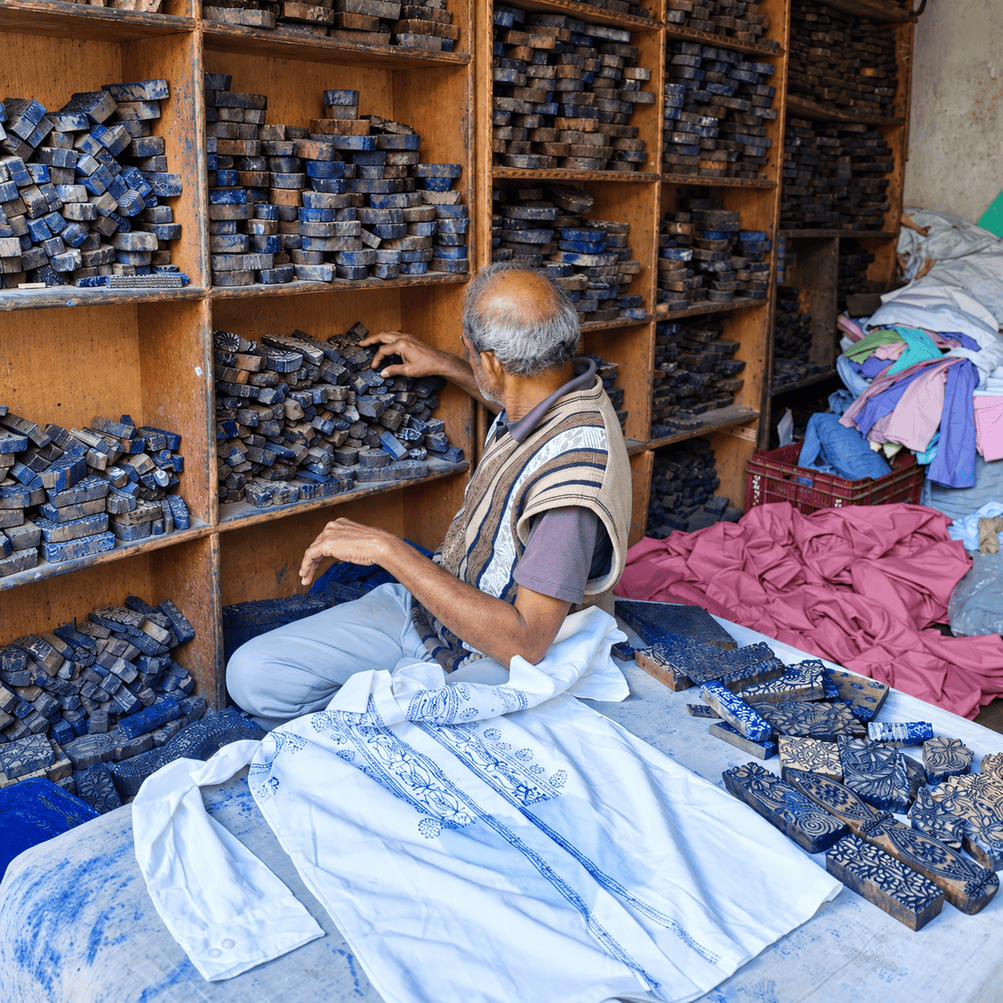
Motif placement, density, coverage and overall visual character can be reviewed against the garment and buyer requirement.
Measurements & Fit
Length, chest, shoulder, sleeves, waist and other critical dimensions can be developed against an approved size specification.
Colour & Finishing
Colour direction, lining, trims, closures and finishing requirements should be documented before approval.
Brand Presentation
If the project is also private label, labels, tags, packaging and related brand requirements can be layered onto the approved product specification.
Custom Manufacturing Workflow
01 — Brief Review
Requirements, references, market, quantity and non-negotiable specifications are reviewed.
02 — Development Direction
Fabric, silhouette, embroidery, measurements and construction route are aligned.
03 — Sample & Revision
A sample is developed, reviewed and revised as needed before final approval.
04 — Commercial Approval
Approved specification, quantity, MOQ, price, payment terms and production plan are confirmed.
05 — Production
Production is planned against the approved reference and documented specifications.
06 — QC, Packing & Dispatch
Finished goods are reviewed against agreed references before packing and dispatch requirements are applied.
02. Sampling Turns the Brief Into a Production Reference
For custom manufacturing, the sample is where assumptions become measurable decisions.
Review:
- fabric, colour and opacity
- embroidery placement and density
- garment measurements and fit
- neckline, sleeve and length
- lining, closures and finishing
- commercial suitability for the target market
Keep the approved sample, measurement notes and written specification together. They should guide production, QC and later reorders.
How Fabric, Embroidery & Construction Affect the Final Product
Fabric Changes the Result
The same silhouette or embroidery direction can behave differently on fabrics with different drape, weight, transparency and surface character.
Embroidery Must Fit the Garment
Placement and density should complement the neckline, sleeve, length and construction rather than being evaluated in isolation.
Construction Affects Cost & Fit
Lining, panels, closures, hems, sleeve construction and finishing can change both the commercial cost and how the garment performs.
MOQ, Pricing and Payment Should Follow the Approved Scope
Custom manufacturing cannot be quoted accurately from a vague idea alone. Quantity, fabric, embroidery, construction, size range, sample development and any branding or packing requirements can influence MOQ and price.
Once the product scope is clear, commercial terms should be documented before production begins, including applicable payment stages for made-to-order work.
Quality Control for Custom Manufacturing
QC is more useful when it is tied to an approved sample and written specification. Without that reference, buyers and manufacturers can interpret the same requirement differently.
Measurements
Check critical dimensions against the approved size specification.
Embroidery
Review placement, overall visual balance and agreed workmanship expectations.
Construction
Check seams, closures, lining, hems, stitching and finishing against the approved product.
Packing
Confirm SKU, size, colour, assortment and packing requirements before dispatch.
Buyer Resources: Read Before You Manufacture
These guides answer related sourcing questions that often come up before buyers move from enquiry to sampling and production.
How to Source Chikankari from India for the USA, UK, Canada, UAE & Australia
A practical international sourcing guide covering suppliers, samples, sizing, labels, landed cost, shipping and customs planning.
Chikankari Wholesale MOQ, Pricing & Profit Margins
Understand MOQ, landed-cost thinking, quote comparison and margin planning before committing to a wholesale order.
Hand Chikankari vs Machine Embroidery: What Wholesale Buyers Should Check
Learn what to inspect before approving samples or bulk orders when embroidery method and authenticity matter to your positioning.
How to Choose a Chikankari Wholesaler in Lucknow: 15 Questions to Ask
Use these sourcing questions to evaluate quality, fabrics, MOQ, samples, sizing, repeat orders, private label and shipping before ordering.
READY TO TURN YOUR PRODUCT BRIEF INTO A SAMPLE?
Discuss Your Custom Chikankari Manufacturing Requirement
Send your category, product references, fabric direction, size requirements, approximate quantity and destination market. If the requirement is suitable for development, the next step can be sampling and specification review before bulk commercial confirmation.
Frequently Asked Questions About Custom Chikankari Manufacturing
Click a question to open the answer.
It is the development and production of Chikankari products against a buyer-defined brief rather than simply selecting an unchanged ready-stock item.
You can submit references and sketches for feasibility review. The final development route depends on fabric, construction, embroidery, measurements, quantity and other project requirements.
A fabric change can be discussed, but it should be evaluated because drape, transparency, embroidery behaviour, construction and price can all change with the fabric.
Measurement and construction changes can be discussed as part of the brief, subject to feasibility and sample approval.
Yes, a buyer-supplied size chart can be used as a development reference once measurements and construction implications are reviewed.
Embroidery direction can be discussed during development. Placement and density should be evaluated together with the fabric, silhouette and intended price position.
For custom development, a sample is a strong control point because it lets both buyer and manufacturer approve the physical product before committing to bulk production.
There is no single timeline for every project. Timing depends on the brief, fabric, embroidery, construction, revisions and buyer approval speed.
MOQ is project-specific and depends on the product, quantity mix, material, development scope and other commercial requirements. It should be confirmed after the brief is reviewed.
Pricing is built around the approved scope, including relevant fabric, embroidery, construction, quantity, size range, development and any branding or packing requirements.
Private-label requirements such as labels, tags or packaging can be discussed in addition to product development where applicable to the project.
You can discuss a test quantity, but feasibility and MOQ still depend on the style, fabric, quantity split and development requirements.
Final quantity, MOQ, price, payment terms, approved specification, production plan, QC expectations, packing and dispatch are confirmed before bulk production.
Any material change should be reviewed again because it may affect feasibility, development, price, MOQ or production timing.
QC should compare finished production against the approved sample, measurement specification and documented product requirements.
International buyers can discuss custom projects. Destination-specific sizing, labels, shipping, documentation and compliance requirements should be confirmed for the actual market.
An approved reference makes reordering clearer, but material availability, current pricing and production feasibility should still be reconfirmed.
Send your business or brand name, country, product category, reference images or sketches, fabric direction, size requirements, approximate quantity and target timeline.