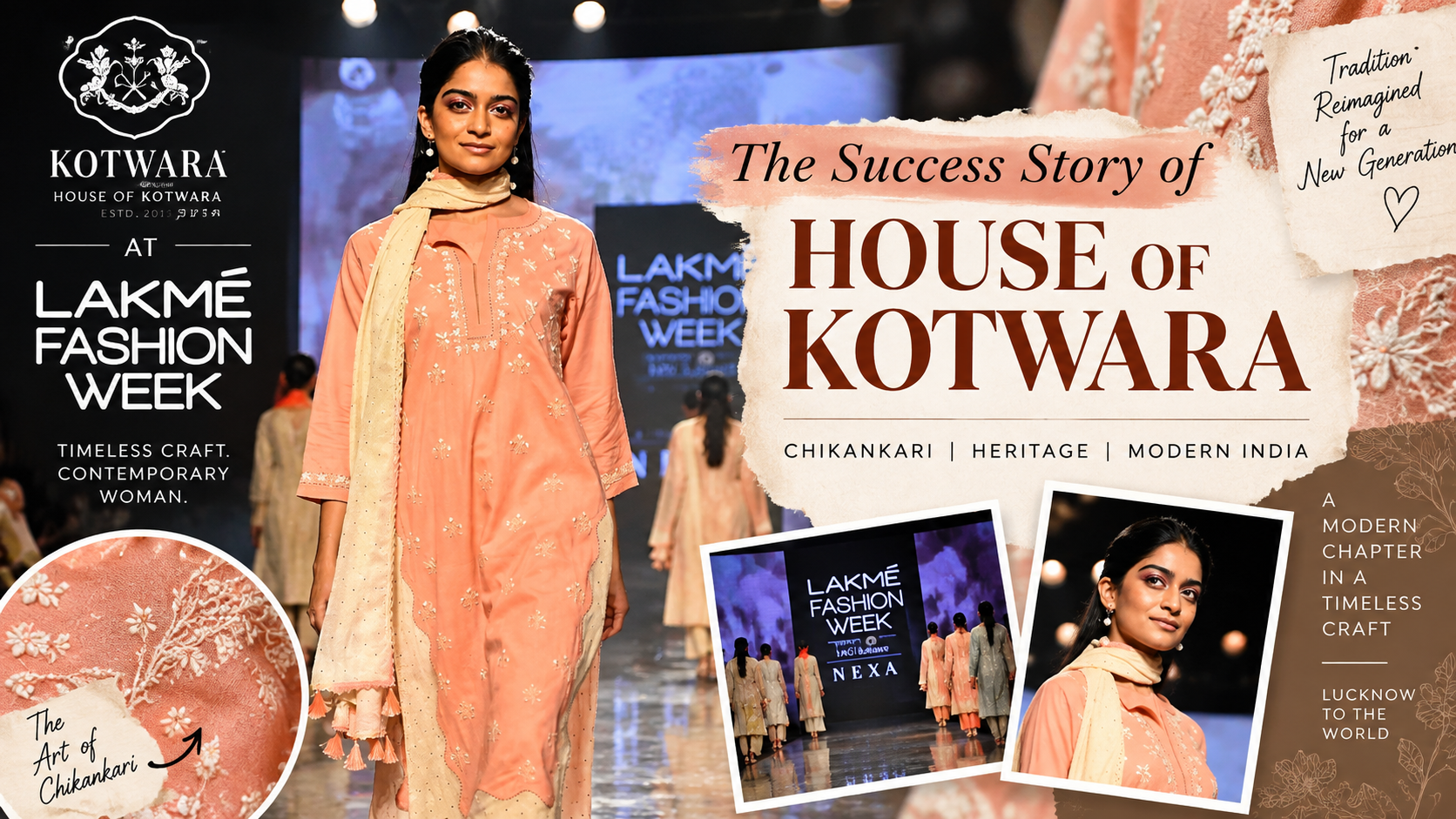
Some fashion businesses begin with a market gap. Others begin with a cultural mission and later discover how to turn that mission into a commercially meaningful brand.
House of Kotwara belongs to the second group. Associated with filmmaker and designer Muzaffar Ali, Meera Ali and later Sama Ali, the house is closely linked with the revival and reinterpretation of Chikankari and other North Indian craft traditions. Its value as a case study lies in how it connects preservation with premium design rather than treating craft revival as charity.
Case study snapshot
| Brand | House of Kotwara |
|---|---|
| Key people | Muzaffar Ali, Meera Ali, Sama Ali |
| Core idea | Revive and reinterpret traditional craftsmanship through fashion |
| Positioning | Luxury / couture craft |
| Strategic lesson | Craft can command premium positioning when design, provenance and execution are treated as one system |
The starting point: revival before scale
House of Kotwara’s story is useful because it reverses the conventional startup sequence. Rather than asking how to produce more units quickly, the founders focused on reviving techniques, creating work around traditional skills and building a distinct design vocabulary.
That is a fundamentally different growth model from commodity wholesale.
When craft is treated as the source of differentiation, the business has to protect the characteristics that make it special. That can mean accepting slower development, higher skill requirements and greater natural variation in exchange for stronger product identity.
Lesson 1: premiumisation requires design intervention
A traditional technique does not become luxury simply because it is handmade.
Premiumisation usually requires:
- strong fabric selection,
- refined silhouettes,
- thoughtful embroidery placement,
- high finishing standards,
- controlled colour palettes,
- distinct styling,
- credible storytelling.
House of Kotwara demonstrates that the craft becomes more valuable when design helps the customer see it differently.
Lesson 2: revival must create a market, not only preserve a technique
Craft revival is economically fragile if there is no customer willing to pay for the resulting product.
The stronger model links preservation to demand. Designers create products customers desire; demand creates orders; orders support skilled work.
That is a useful principle for any Chikankari manufacturer. Artisan livelihoods and commercial viability are not opposing goals when the product has a clear market.
Lesson 3: changing the vocabulary of Chikankari can expand its value
Meera Ali has spoken publicly about changing the vocabulary of Chikankari rather than simply reproducing what already existed.
That idea matters. A heritage craft grows when designers understand its grammar well enough to innovate without making it unrecognisable.
Innovation may involve:
- new base fabrics,
- different garment shapes,
- unexpected scale of motifs,
- layering with complementary techniques,
- new colour relationships.
For buyers, this is why two Chikankari products cannot be judged only by “amount of work.” Design quality changes perceived value.
Lesson 4: provenance supports luxury when it is specific
Luxury customers respond to provenance when it explains why a product exists and who made it possible.
Generic “handcrafted in India” language is much weaker than specific knowledge about:
- where the craft comes from,
- which technique is used,
- what the design process involved,
- why the fabric was chosen,
- how much variation is inherent in the work.
Our Chikankari stitches guide is useful for buyers who want to understand the craft language more deeply.
Lesson 5: intergenerational continuity can strengthen a craft house
As Sama Ali became more involved, House of Kotwara gained a second-generation perspective. This is important because heritage businesses need renewal as much as continuity.
The next generation can bring new customers, digital communication and contemporary styling while the older generation protects institutional knowledge.
The strategic balance is to evolve the expression without erasing the underlying expertise.
What wholesale businesses can learn
Not every wholesaler should become a couture house. But several principles transfer directly:
- Do not sell handwork as a commodity if it is genuinely differentiated.
- Use fabric and silhouette to create value around embroidery.
- Explain provenance accurately.
- Build collections, not random products.
- Protect quality when scaling.
For retailers planning different value tiers, see our Chikankari wholesale price-ladder guide.
Why this case matters for ChikankariWholesale buyers
House of Kotwara shows the upper end of what craft positioning can become. A boutique does not need couture pricing to learn from that model. It can still improve assortment quality by choosing products where fabric, embroidery and silhouette make sense together.
If you are sourcing a differentiated Chikankari collection, review the wholesale catalogue and specify your target customer, quantity, price tier and destination when requesting options.
Sources and methodology
This article draws on public interviews with Meera and Sama Ali, including the Blur The Border conversation on House of Kotwara, together with the house’s published brand history. Interpretive business lessons are our analysis, while founder and brand history details are attributed to those sources.