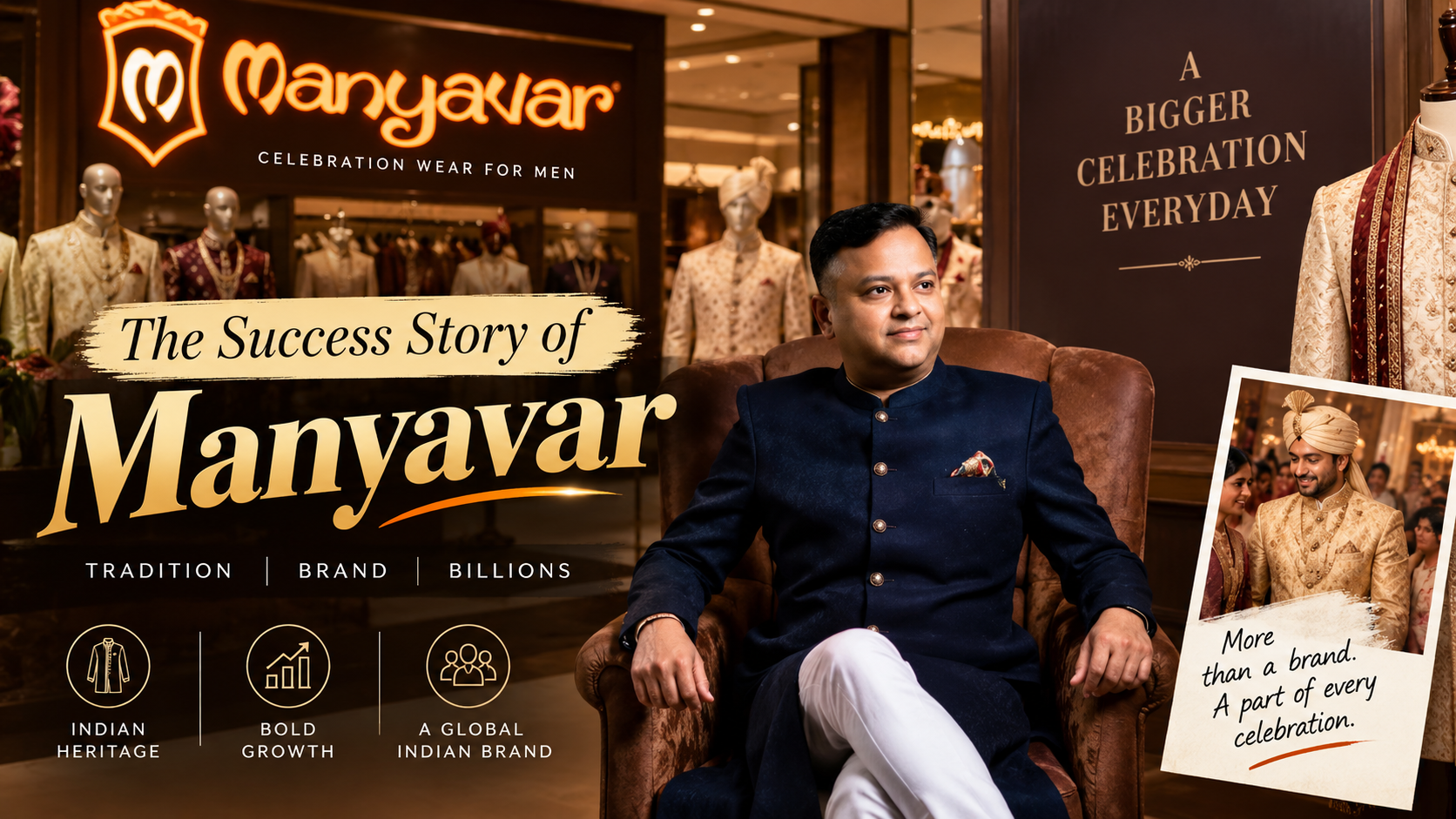
Manyavar is a valuable case study because it shows what happens when a company decides not merely to sell ethnicwear, but to own a very specific buying occasion in the customer’s mind.
Ravi Modi built Vedant Fashions around Indian celebration wear, with Manyavar becoming strongly associated with men’s wedding and festive dressing. Public profiles describe a path that began with distribution through multi-brand outlets and expanded into exclusive brand stores as the model proved itself.
Case study snapshot
| Brand | Manyavar / Vedant Fashions |
|---|---|
| Founder | Ravi Modi |
| Core category | Indian celebration wear |
| Early route to market | Multi-brand retail distribution |
| Growth route | Category focus followed by exclusive branded retail expansion |
| Strategic lesson | Owning a clear occasion can be more powerful than competing across all apparel |
The opportunity: dominate a narrow category before expanding
One of Manyavar’s strongest strategic decisions was focus. Rather than trying to compete across casualwear, westernwear and every ethnicwear category, the brand built recognition around weddings, festivals and celebration dressing.
This matters because customer memory is limited. A specialist brand is easier to recall at the moment of purchase.
For Chikankari businesses, the equivalent could be owning:
- premium Lucknow Chikankari,
- white Chikankari,
- bridal or occasion Chikankari,
- everyday Chikankari,
- private-label Chikankari manufacturing.
Lesson 1: distribution can create brand awareness before owned stores
Public business profiles describe Manyavar growing first through multi-brand outlets. This gave the company access to customers without carrying the fixed costs of an immediate national store network.
That sequence is important. Distribution creates reach. Owned retail creates control. Mature brands often need both, but not necessarily at the same time.
For emerging craft brands, wholesale can play the same role. Selling through boutiques can help establish demand before investing heavily in direct retail infrastructure.
Lesson 2: category ownership simplifies marketing
A broad fashion brand has to explain itself repeatedly. A celebration-wear specialist has a stronger trigger: weddings and festivals.
This makes marketing easier because campaigns can connect with predictable occasions rather than trying to create demand from nothing.
Chikankari retailers can use the same principle with seasonal buying. Our festive Chikankari wholesale guide shows how to plan stock around real buying windows.
Lesson 3: disciplined expansion protects cash
Manyavar’s growth story is frequently associated with financial discipline and careful store expansion rather than growth at any cost.
This is especially relevant in fashion, where inventory and rent can destroy otherwise healthy demand.
Retailers should therefore measure:
- sell-through,
- inventory age,
- full-price sales,
- store or channel profitability,
- reorder performance.
Our fast- vs slow-moving Chikankari stock guide applies the same discipline at SKU level.
Lesson 4: occasion categories support premium price architecture
Customers often accept different price levels for emotionally important purchases such as weddings. That creates room for entry, mid and premium tiers inside the same category.
The key is not to overprice ordinary product. Higher tiers need visible differentiation through fabric, embroidery, styling, finishing and presentation.
Lesson 5: consistency matters more as distribution grows
When a brand expands across many stores, inconsistent fit or quality becomes harder to hide.
Scale requires:
- repeatable sizing,
- clear specifications,
- strong quality control,
- inventory systems,
- consistent presentation.
Craft businesses need to decide which parts of the product can vary naturally and which must remain standard.
What Chikankari businesses can learn
- Own one clear buying occasion or category.
- Use wholesale and multi-brand distribution as a growth route.
- Expand fixed-cost retail only after demand is proven.
- Build clear price tiers inside the category.
- Protect consistency as distribution expands.
What wholesale buyers should take from this case
Manyavar’s success is not an argument that every retailer should become a national chain. The useful principle is concentration.
A boutique can often perform better with a clearly merchandised Chikankari proposition than with a random mix of ethnicwear categories.
Use our Chikankari product-mix planning guide to define category roles before selecting stock.
Sources and methodology
This article draws on public profiles of Ravi Modi and Vedant Fashions, including Forbes India’s profile of the Manyavar growth story. Business lessons are analytical interpretations of the documented strategy.