Many textile brands have good products. Far fewer make customers feel emotionally connected to those products before purchase.
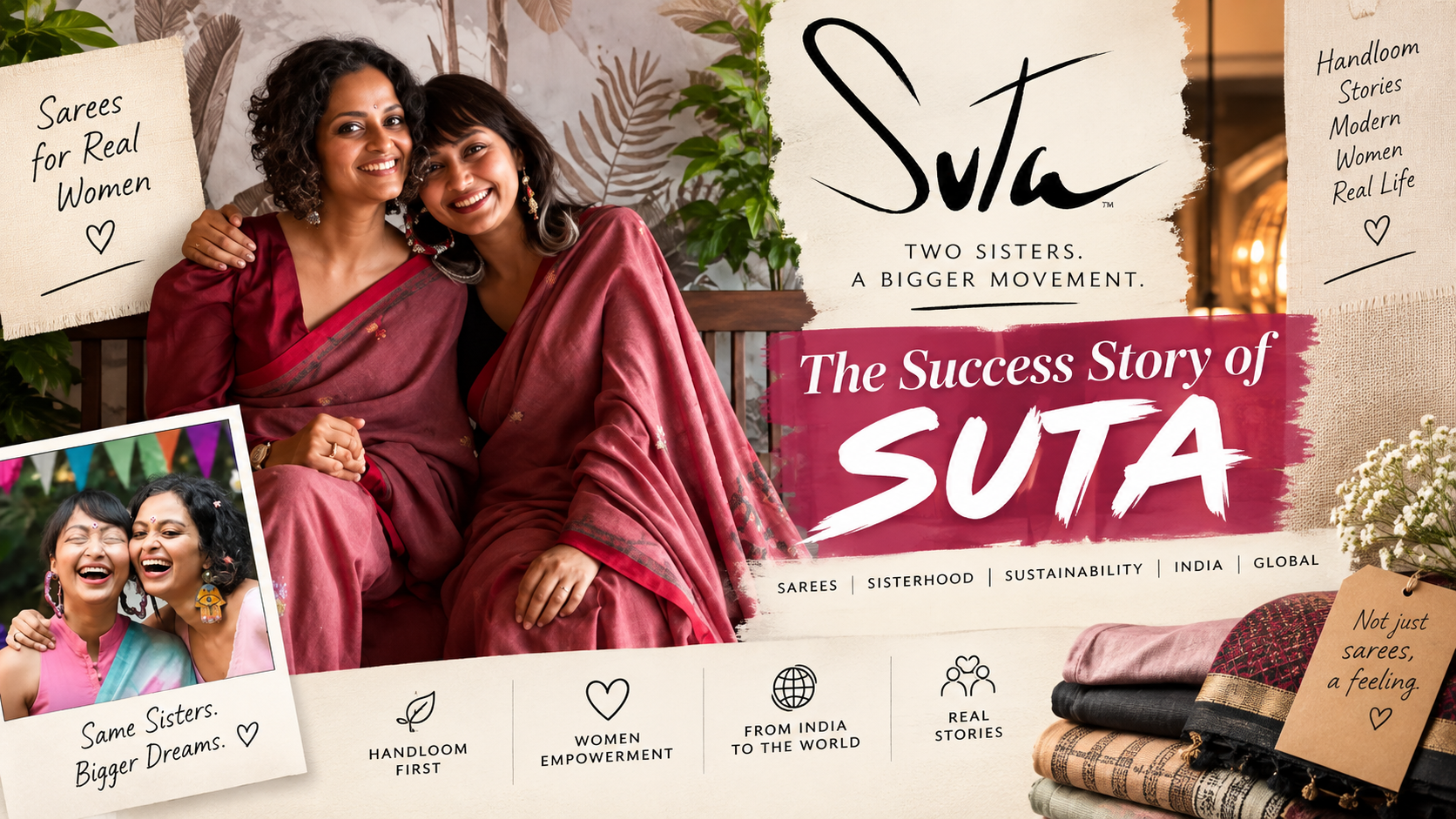
Suta, founded by sisters Sujata and Taniya Biswas, is a useful case study because storytelling is not a decorative layer around the business; it is part of the product experience. The brand built recognition around Indian textiles, sarees and craft-led clothing while using warm, human communication to make traditional products feel contemporary rather than formal or distant.
Case study snapshot
| Brand | Suta |
|---|---|
| Founders | Sujata Biswas and Taniya Biswas |
| Core category | Sarees and Indian textile-led fashion |
| Growth model | Bootstrapped D2C, community-led storytelling, later offline expansion |
| Strategic lesson | Emotional storytelling works when it is attached to distinctive product and a consistent customer experience |
The opportunity: make traditional products feel personally relevant
Sarees carry enormous cultural recognition, but younger customers can also perceive them as formal, difficult or reserved for specific occasions.
Suta’s communication helped challenge that barrier by presenting sarees as personal, expressive and wearable in everyday life.
That principle applies directly to Chikankari. A craft grows when customers find more reasons to wear it.
Lesson 1: storytelling should create memory
Suta became known for naming and describing products in a distinctive voice rather than treating them as anonymous SKUs.
That creates memory. Customers are more likely to remember a product with personality than “Cotton Saree 1478”.
For Chikankari retailers, storytelling can work in the same way, but it should remain accurate. Explain the fabric, embroidery, inspiration and use without inventing artisan biographies or unsupported heritage claims.
Lesson 2: make the customer feel part of a community
D2C brands benefit when communication feels two-way rather than like catalogue advertising.
Community can be built through:
- founder visibility,
- customer styling,
- behind-the-scenes content,
- real product education,
- consistent social voice,
- responsive service.
This is especially powerful for craft categories because customers often want to understand where the product came from and how to style it.
Lesson 3: accessibility can coexist with craft
Traditional textiles do not have to be presented only as precious objects.
One of Suta’s strengths has been making sarees feel approachable. The broader lesson is that lowering psychological barriers can expand a category without necessarily lowering product integrity.
For Chikankari, this might mean:
- short kurtis for jeans,
- easy co-ords,
- lightweight everyday fabrics,
- simple size guidance,
- clear care instructions.
Lesson 4: brand voice can differentiate a product that competitors can also sell
Indian textile markets contain many visually similar products. A strong voice helps the customer distinguish the brand even when the underlying category is widely available.
But brand voice cannot compensate for weak product. Storytelling works best when quality, design and service support it.
Lesson 5: content can reduce education friction
Customers may hesitate because they do not know how to drape, style, wash, size or evaluate a traditional product.
Content that answers those questions does more than attract traffic. It removes objections.
That is the same logic behind the ChikankariWholesale Knowledge Centre: teach the buyer enough to make a better sourcing decision.
Lesson 6: move offline after building a strong direct relationship
Like several modern Indian fashion brands, Suta later expanded its physical presence after establishing substantial digital recognition.
This sequence has an advantage: the brand enters offline retail with a customer base, product knowledge and clear identity rather than using stores to discover what it stands for.
Lesson 7: storytelling needs operational credibility
As a company grows, romantic craft storytelling can create higher expectations. That makes operational discipline even more important.
Customers expect:
- accurate product representation,
- reliable delivery,
- clear policies,
- consistent quality,
- responsive support.
Emotion wins attention; execution wins repeat business.
What Chikankari businesses can learn
- Give traditional products contemporary use cases.
- Build a recognisable human voice.
- Use education to remove buying friction.
- Create community around the craft, not just promotions.
- Make sure operations support the story.
What wholesale buyers can take from Suta
A boutique does not need to copy Suta’s voice to learn from its model. The useful principle is to make products easier to understand and emotionally easier to buy.
When sourcing Chikankari, think beyond individual pieces. Ask how the assortment will be photographed, grouped, named, styled and explained to your customer.
Our Chikankari boutique merchandising guide helps translate sourcing into a stronger retail presentation.
Sources and methodology
This article draws on public founder and business coverage, including YourStory’s feature on Suta’s growth story, alongside the brand’s public communications. Business lessons are analytical interpretations rather than claims that every element of Suta’s model will transfer directly to another business.