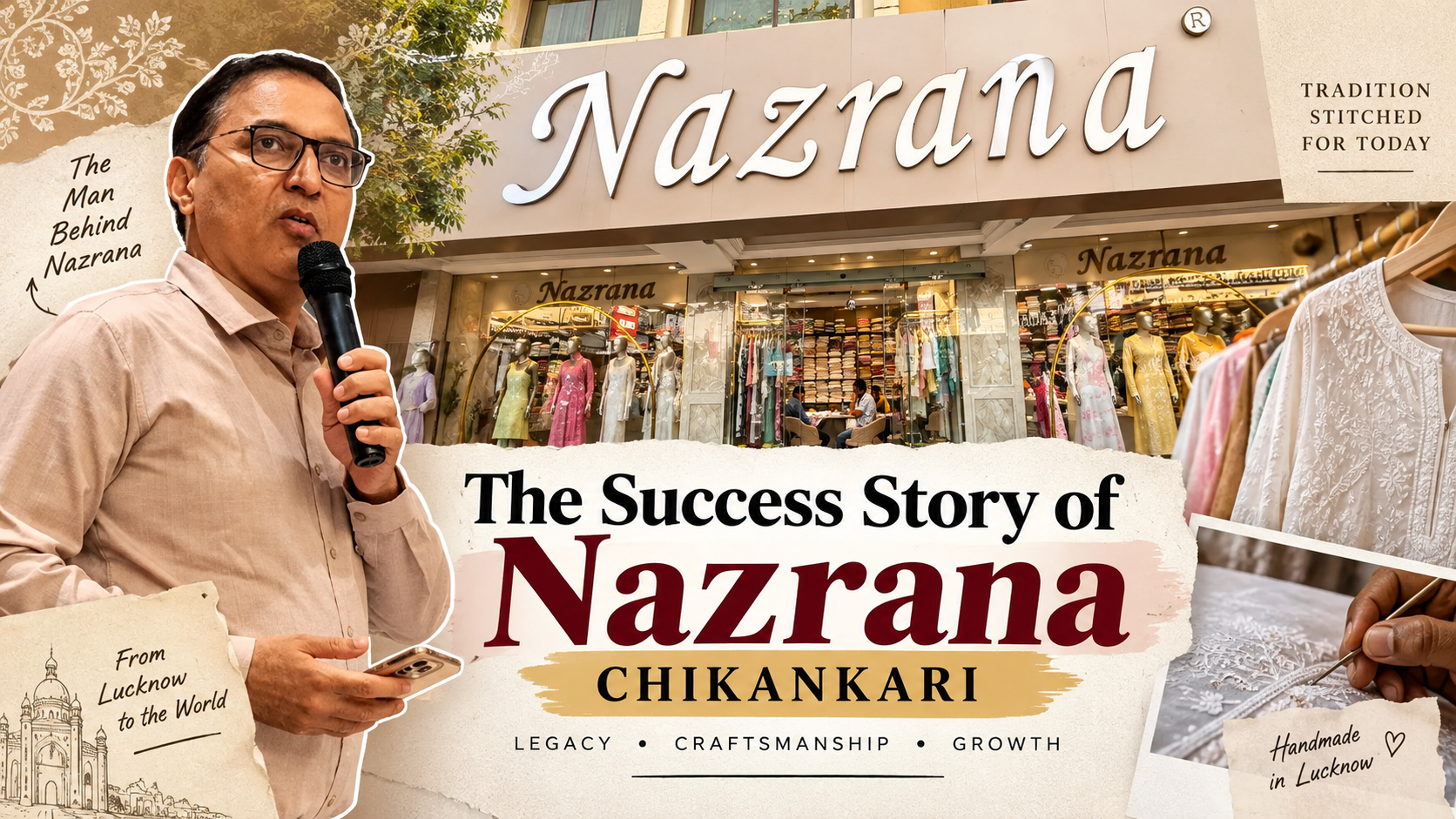
Some businesses are born digital. Others have to become digital without losing what made them valuable offline.
Nazrana Chikan is a strong example of the second path. The company traces its roots to Lucknow and a long-standing Chikankari business, while Google later documented how it accelerated online selling when the pandemic disrupted physical retail. That makes the brand useful for a different reason than a typical startup story: it shows how an established craft business can modernise distribution without starting from zero.
Case study snapshot
| Brand | Nazrana Chikan |
|---|---|
| Base | Lucknow |
| Business roots | 1981, according to public company history |
| Core category | Chikankari apparel and craft-led retail |
| Transformation point | Accelerated digital commerce during the pandemic |
| Strategic lesson | Digitisation works best when it transfers existing trust and product knowledge online |
The challenge: a strong offline business can still be digitally vulnerable
Traditional retail businesses often believe longevity itself protects them. It does not. A business may have loyal customers, supplier relationships and local reputation while still depending heavily on physical footfall.
When COVID-19 disrupted store traffic, that dependency became visible across retail. Google’s case study on Nazrana describes the business using digital tools to bring traditional clothing sales online and sustain the artisan network connected to the company.
Lesson 1: digital transformation should begin with the customer, not the technology
Moving online is not simply creating a website. The real work is translating what customers used to receive in-store into digital form.
In a Chikankari store, a buyer can touch fabric, inspect embroidery, compare pieces and ask questions. Online, those functions must be recreated through:
- clear product photography,
- close-up embroidery images,
- accurate fabric descriptions,
- size information,
- responsive customer support,
- trustworthy fulfilment communication.
The lesson is important for wholesalers too. A digital catalogue is only useful when buyers can make decisions from it. See our guide on how to read a Chikankari wholesale catalogue.
Lesson 2: heritage gives a business proof, but not immunity
A company with decades of history has an advantage that a new startup cannot manufacture: accumulated trust.
But heritage can become a weakness if it creates resistance to new channels. Nazrana’s transition illustrates that the better question is not “online or offline?” but “how do we carry the strengths of the old model into the new one?”
For established Chikankari businesses, that may mean bringing existing customer relationships, sourcing knowledge, quality benchmarks and artisan connections into ecommerce instead of rebuilding the brand as if none of that history existed.
Lesson 3: the artisan network is part of business continuity
In craft-led supply chains, demand shocks affect more than the retailer. They travel backward into stitching, embroidery, finishing and artisan livelihoods.
That is why digital demand generation can have operational significance. If online sales help keep orders moving, they can support continuity through the wider production network.
This is a useful reminder for brands that talk about artisan impact: impact is strongest when it is tied to a commercially sustainable demand engine.
Lesson 4: digitising a traditional business requires new capabilities
An offline retailer may already understand the product extremely well but still need new skills in:
- performance marketing,
- content creation,
- catalogue management,
- online payments,
- shipping integration,
- customer-service systems,
- inventory accuracy,
- analytics.
The strategic mistake is to assume that product knowledge automatically creates digital competence. The stronger model combines both.
Lesson 5: trust must become visible online
Offline trust is physical. Customers see the store, staff and stock.
Online trust needs evidence. That includes:
- clear policies,
- real product images,
- contact information,
- accurate descriptions,
- reviews where genuine,
- transparent shipping expectations,
- consistent branding.
For wholesale buyers, the same principle applies when evaluating suppliers remotely. Our 15-question wholesaler checklist helps structure that evaluation.
Lesson 6: digital can expand geography without abandoning local identity
A Lucknow craft business no longer has to depend only on customers who can physically reach Lucknow.
That changes the economics of niche categories. A specialised business can serve customers nationally and internationally if the online proposition removes enough uncertainty.
This is particularly relevant for Chikankari because provenance matters. The internet can extend the market while Lucknow remains central to the story and product knowledge.
What modern Chikankari businesses can learn
- Do not wait for disruption to build digital capability.
- Transfer offline trust into online evidence.
- Use ecommerce to broaden geography, not dilute identity.
- Protect the production network by creating resilient demand channels.
- Combine traditional product expertise with modern operational systems.
What this means for wholesale buyers
The Nazrana story also changes what buyers should expect from suppliers. Modern wholesale relationships increasingly require digital catalogue access, fast specification sharing, remote sampling, shipment communication and clear documentation.
If you source Chikankari remotely, use the wholesale catalogue as a starting point, but confirm exact fabric, embroidery, MOQ, sizes, stock status and repeatability before ordering.
Sources and methodology
This article draws on Grow with Google’s Nazrana case study and the company’s own published history. Company-specific historical details are treated as brand-stated where independent verification is unavailable.