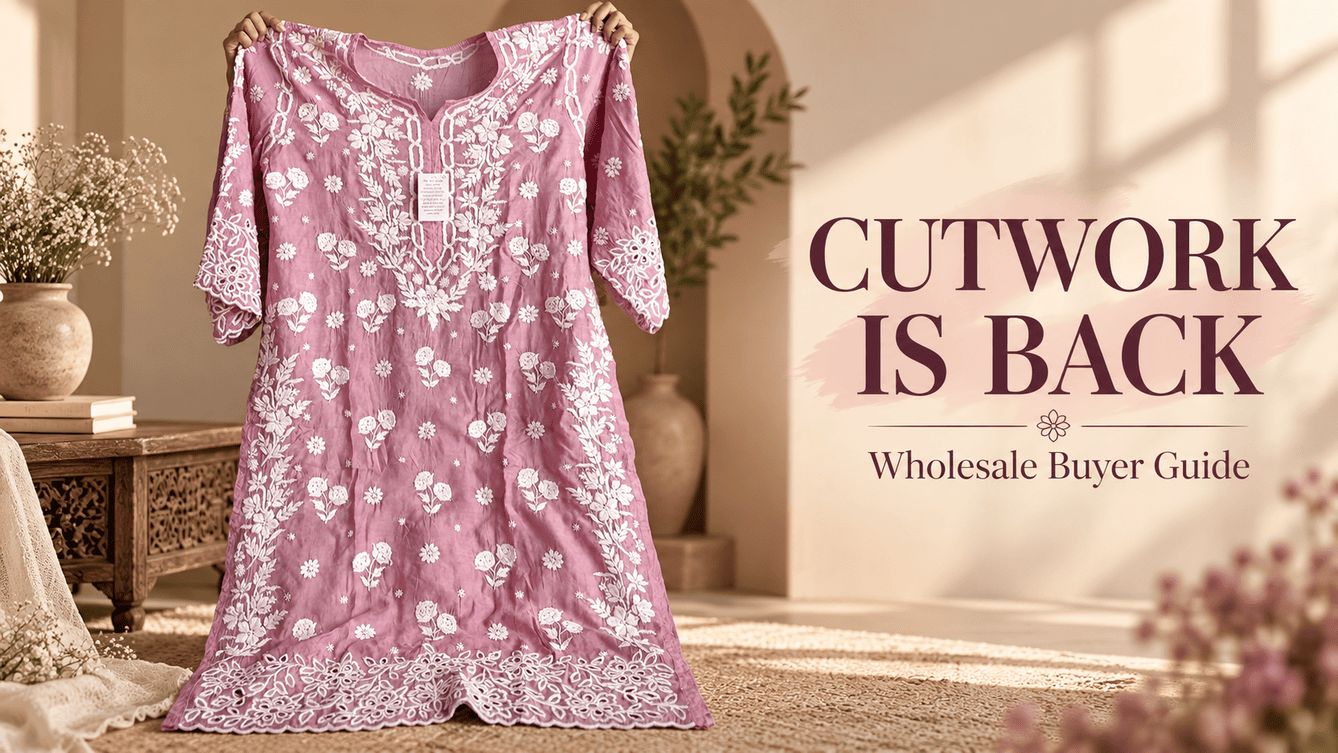
Cutwork Chikankari Is Rising Again: A Wholesale Buyer’s Guide to the Trend
Cutwork is one of those details that can make a garment look immediately more intricate in a product photograph. That visual impact is exactly why the renewed interest matters to boutiques: it can raise perceived value, create stronger close-up content and help a product stand apart from basic embroidered kurtas.
But “cutwork” is also a term that gets used loosely. For a wholesale buyer, the important work begins after the trend catches your attention. You need to know what has actually been cut, how the edges are secured, whether the fabric is stable, how the technique interacts with Chikankari, and whether the product can survive normal wear.
Lucknow market reporting in August 2026 noted rising demand for cutwork alongside the Farshi-salwar revival. This guide turns that signal into a practical procurement checklist.
Quick answer: what should wholesale buyers look for?
Do not buy cutwork Chikankari from a front-view image alone. Ask for close-up photos and video of the cut areas, reverse side, seams and finished edges. Check whether openings are intentional and securely finished, whether the fabric frays, whether the embroidery supports or weakens the cut area, and whether multiple pieces show consistent construction.
Why cutwork is getting attention
Recent coverage from Amar Ujala reported increased cutwork demand in Lucknow. Retailers should read this as directional evidence: consumers are responding to garments that offer more visible craft and surface detail.
Cutwork also works well in digital merchandising because it gives the retailer a detail story. A close crop of a cleanly finished open-work area can communicate craftsmanship faster than a generic full-length image.
Cutwork and Chikankari are not automatically the same technique
One of the first jobs of a buyer is terminology control.
Chikankari contains stitches and techniques that can create open, lace-like or mesh effects. Cutwork, by contrast, generally involves deliberate removal or cutting of fabric areas that are then secured through embroidery or edge finishing. Suppliers may combine the two, but the label should reflect what is actually present.
Ask the supplier:
- Which part of the garment is Chikankari?
- Which part is cutwork?
- Is any open effect created by thread manipulation rather than fabric cutting?
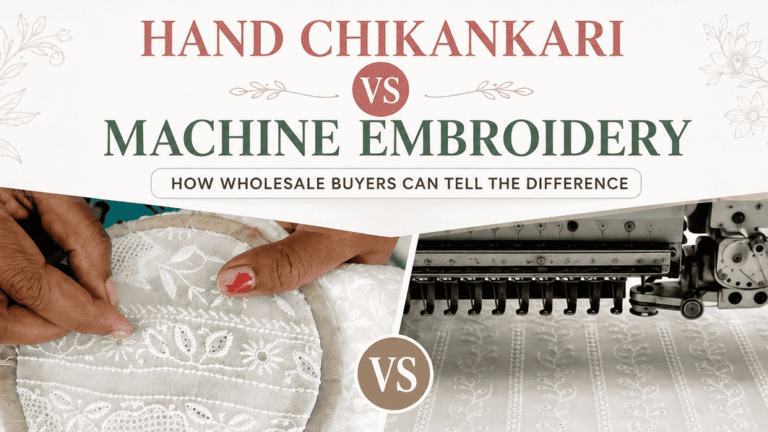
- Is the work hand executed, machine executed or mixed?
For stitch vocabulary, review our Chikankari stitches guide.
The five technical checks that matter most
1. Edge security
Every cut opening creates an edge that can potentially fray or distort. Inspect how the edge is bound or embroidered. Loose fibres around new stock are an early warning sign.
2. Fabric stability
Fine fabrics can look beautiful with open work but may require more careful handling. The base cloth must be able to support the cut without collapsing around it.
3. Placement
Cutwork near high-tension zones such as armholes, side seams or heavily stressed openings requires more caution than decorative work placed in stable areas.
4. Repeat consistency
Compare several units. In handcrafted products, small variation is normal; structural inconsistency is not.
5. Finishing on the reverse
Turn the garment over. Poor reverse-side finishing can irritate the wearer, snag during dressing or unravel after use.
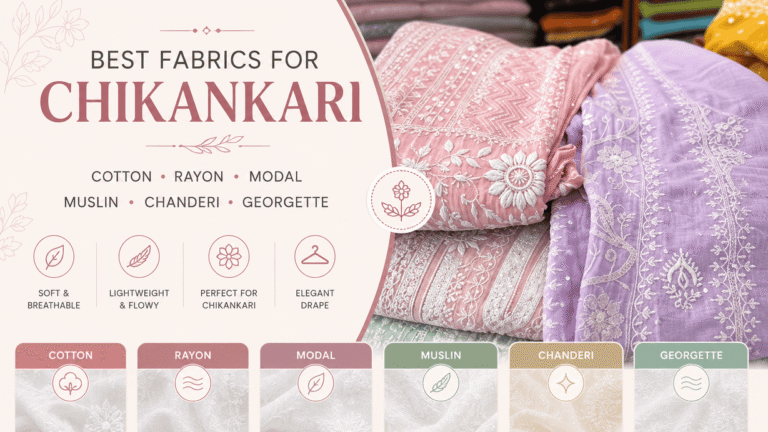
Which fabrics should buyers compare?
| Fabric family | Potential advantage | Buyer caution |
|---|---|---|
| Cotton | Stable, breathable base for many everyday products | Weight and weave density vary considerably |
| Chanderi-type fabrics | Elevated visual finish and lightness | Confirm composition, transparency and edge behaviour |
| Modal/rayon | Soft drape and contemporary hand-feel | Check whether cut sections distort under movement |
| Georgette | Fluid, occasion-led look | Fine fabric and open work may require careful lining/finishing |
| Muslin | Soft and lightweight | Exact weave and strength should be checked on sample |
See our Chikankari fabric guide before approving material substitutions.
Where cutwork works best in a commercial assortment
Cutwork can play several roles:
- neckline detail: easier entry point for everyday products,
- sleeve detail: visually strong in close-up photography,
- hem or border: creates movement and a finished edge story,
- front-panel emphasis: stronger statement product,
- all-over/open-work effect: premium or occasion-led but requires higher QC attention.
Do not assume more cutwork equals more commercial value. The right amount depends on price point, fabric, intended customer and how often the garment will be worn.
How cutwork affects wholesale pricing
The price difference can come from several places:
- additional embroidery or securing around cut areas,
- more careful handling and finishing,
- higher rejection risk when a cut goes wrong,
- fabric requirements,
- lining or construction changes,
- inspection time.
Ask for an itemised explanation rather than assuming the price is higher because the supplier calls the design “premium.” Our guide on why Chikankari wholesale prices differ helps compare like-for-like quotations.
Quality-control checklist for cutwork pieces
- Inspect every cut edge for loose fibres.
- Check symmetry where the design is intended to be symmetrical.
- Look for accidental cuts outside the motif.
- Test whether the fabric pulls around openings.
- Check seams near open-work zones.
- Confirm lining where needed.
- Check embroidery thread tension.
- Inspect the reverse for knots or roughness.
- Compare motif placement across multiple pieces.
- Measure the garment after finishing, not before embroidery.
- Check colour consistency across batch pieces.
- Test buttons/hooks/zips if cutwork is near closures.
A wider inspection framework is available in our 25-point Chikankari wholesale quality checklist.
How to photograph cutwork for ecommerce
Cutwork is wasted commercially if the customer cannot see it.
Your image set should include:
- full garment front view,
- macro close-up against a contrasting background where appropriate,
- reverse or interior detail if the construction is part of the value story,
- side-lighting that reveals openings without overexposing fabric,
- a worn view so customers understand transparency and placement.
Do not digitally “clean” handmade detail until it becomes perfectly regular. The embroidery and fabric should remain visually truthful.
What to ask before approving a sample
Send a written approval checklist:
- base fabric and composition,
- colour reference,
- exact cutwork placement,
- embroidery technique,
- thread colour,
- lining instruction,
- measurement chart,
- acceptable variation,
- packing method.
Use the Chikankari sample approval checklist before bulk production.
Common sourcing mistakes
Buying by trend name
“Cutwork” tells you almost nothing about construction quality.
Ignoring durability
A dramatic sample that cannot survive normal handling is a poor retail product.
Failing to define hand vs machine work
If your product page will make a specific technique claim, verify it in writing.
Overloading the assortment
Use cutwork as a distinctive part of the range rather than putting the same treatment on every SKU.
Frequently asked questions
Is cutwork Chikankari always handmade?
No. The presence of cutwork does not prove the production method. Ask the supplier how the embroidery and cut areas are executed.
Does cutwork make a garment fragile?
Not necessarily. Durability depends on fabric stability, placement, finishing and how the cut edges are secured.
Should I request a physical sample?
For a new supplier or a structurally detailed design, a sample is highly valuable because photographs cannot fully show edge quality, fabric strength and reverse-side finishing.
Is cutwork suitable for everyday Chikankari?
Yes when used selectively on a stable fabric with practical placement. Heavier open-work treatments may fit occasion products better.
Final takeaway
The opportunity in cutwork is not simply that it is gaining attention. It is that the technique can give a Chikankari assortment a new level of visible detail. The buyer’s job is to make sure that visual interest is supported by good fabric, secure edges, accurate technique claims and repeatable quality.
To discuss suitable Chikankari options for your store, review the wholesale catalogue and send shortlisted products through the RFQ page.