Why Farshi Salwar Is Back in 2026: What Chikankari Boutiques Should Stock Now
Farshi salwar has moved from heritage reference to active retail conversation again. In August 2026, Lucknow market reporting highlighted a comeback in Farshi salwar suits alongside renewed demand for cutwork. That matters to Chikankari buyers because Lucknow sits at the centre of both the craft and the commercial ecosystem that develops new combinations of embroidery, fabric and silhouette.
For a boutique, however, “a trend is back” is not enough reason to place a bulk order. The more useful questions are: Which Farshi silhouettes are actually wearable? Which fabrics support the volume? How should the kurta, salwar and dupatta be balanced? What will make the set photograph well online? And how much stock should be tested before scaling?
This guide approaches Farshi salwar as a wholesale buying decision rather than a styling fad.
Quick answer: should a Chikankari boutique add Farshi salwar now?
Yes, it is worth testing if your customer buys festive, occasion, heritage-inspired or fashion-forward ethnicwear. But do not build the whole range around it immediately. Start with a small, clearly differentiated edit and compare sell-through against your existing straight-pant, palazzo and traditional suit-set categories.
Farshi is strongest when it gives the customer a visible reason to buy: volume, movement, a more dramatic silhouette, coordinated Chikankari placement and an outfit that feels different from another standard kurta set.
What exactly is a Farshi salwar?
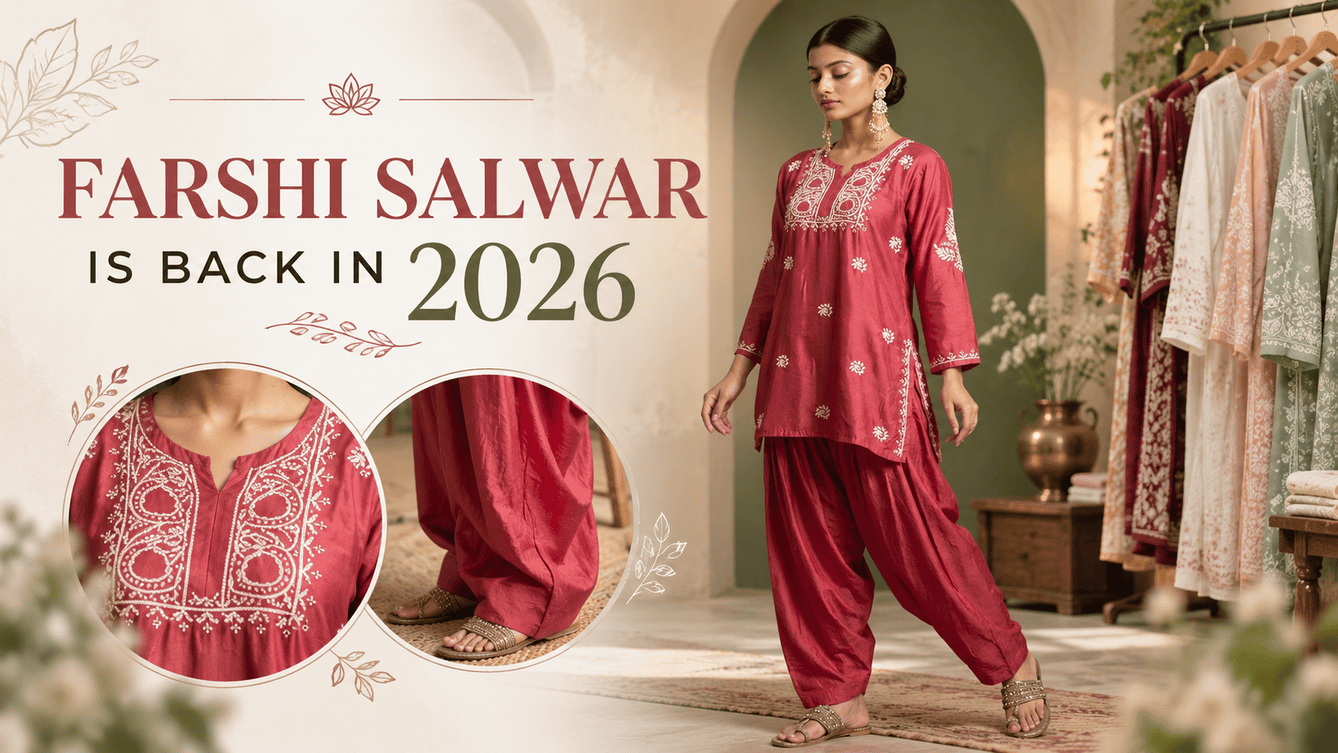
A Farshi salwar is a generously cut lower garment with substantially more volume than a straight trouser or conventional narrow salwar. Historically, the silhouette is associated with courtly dress and floor-skimming proportions. Contemporary versions are often adapted for easier movement and modern retail use.
That distinction matters. A boutique should not assume every product using the word “Farshi” has the same cut. Ask the supplier for:
- full front and back images,
- salwar length and waistband construction,
- hem circumference or garment width where relevant,
- fabric composition,
- whether the volume begins at the waist or lower down,
- how the garment is intended to fall with the kurta.
Why the silhouette is commercially interesting in 2026
1. It looks visibly different in a crowded kurta-set market
Many retailers already carry straight kurta-pant sets. Farshi creates a stronger silhouette change without forcing the customer into a completely unfamiliar garment category.
2. It photographs with movement
Wide, flowing bottoms create motion in reels and campaign photography. For ecommerce and social selling, that visual difference can help the product communicate before the customer reads the description.
3. It fits the current return to expressive Indian silhouettes
Contemporary Indianwear is moving between practicality and drama rather than choosing only one. Farshi can sit between a formal suit set and heavier occasionwear.
4. It gives Chikankari a new merchandising context
Chikankari is often shown on straight kurtas. Pairing the work with a Farshi bottom changes the overall proposition and can help a retailer create a new story without abandoning a familiar craft.
The Lucknow demand signal buyers should know
Recent Lucknow coverage from Amar Ujala reported a return in demand for Farshi salwar suits. This should be treated as a market signal, not proof that every boutique will see identical demand.
Your own customer data still matters more: enquiries, saves, try-ons, conversions, size sell-through and reorders.
What a Chikankari Farshi set should be judged on
| Buying factor | What to inspect | Why it matters |
|---|---|---|
| Kurta proportion | Length, flare and side opening | The kurta should not visually fight the wide salwar |
| Farshi volume | Width and fall | Too little volume loses the Farshi effect; too much can reduce wearability |
| Fabric | Drape, opacity, weight | The same cut behaves very differently in stiff and fluid fabrics |
| Embroidery placement | Kurta, hem, salwar, dupatta | Work should support the silhouette rather than make it visually heavy |
| Set composition | 2-piece or 3-piece | Changes price, styling and occasion positioning |
| Size specification | Waist, hip, length and kurta measurements | Wide bottoms still require precise fit information |
| Finishing | Hem, seams, thread trimming | Large hems expose poor finishing quickly |
Which fabrics work best with Farshi-style Chikankari?
There is no single “best” fabric. The choice depends on the customer and the desired fall.
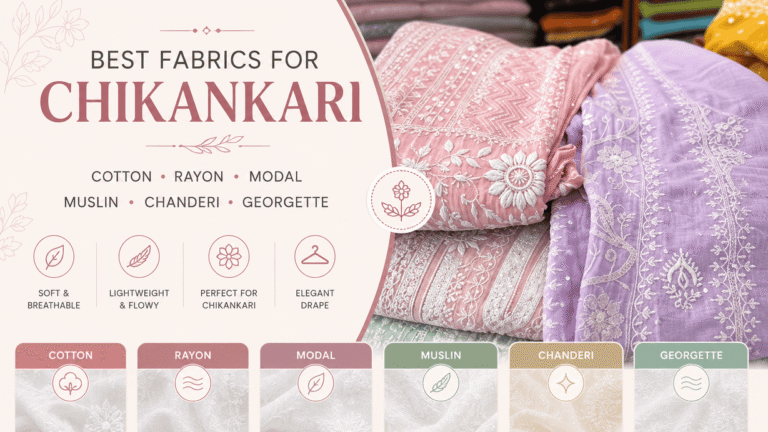
Chanderi
Chanderi-type fabrics can give a more elevated visual finish and work well when the retailer wants a festive or premium story. Because Chanderi can vary widely in composition and structure, confirm the exact fabric rather than relying only on the name.
Modal and rayon
These can create a softer, more fluid fall, which can make a high-volume bottom easier to wear. Buyers should check how the fabric behaves after embroidery and finishing.
Muslin
Muslin can work where a lighter, softer set is required, but again the exact weave and weight matter.
Georgette
Georgette can produce movement and occasion appeal, especially where the set includes a dupatta or additional embellishment. Transparency and lining need to be confirmed.
For a broader comparison, use our Chikankari fabric comparison for wholesale buyers.
2-piece or 3-piece Farshi set?
A two-piece set can be easier to merchandise as a contemporary statement outfit. A three-piece set with dupatta moves the product toward festive and occasion dressing.
Do not assume the 3-piece option is automatically better. Ask:
- Does the dupatta add enough perceived value?
- Does it increase the landed cost beyond your customer’s comfortable price band?
- Will customers actually use it?
- Is the embroidery balanced across all three pieces?
How much Farshi stock should a boutique test?
There is no universal number. Your test should be large enough to include meaningful size and colour variation but small enough that one trend does not consume disproportionate inventory budget.
A useful test structure is:
- Choose 2–4 clearly different designs rather than ten near-identical ones.
- Keep the first colour story tight.
- Use a size mix based on your own previous sales.
- Launch all test SKUs in the same period.
- Measure sell-through, enquiries, size stockouts and return reasons.
- Reorder only the combinations that show evidence.
Our low-risk Chikankari collection testing guide explains this process in more detail.
Common Farshi buying mistakes
- Buying from one front image: the bottom volume is impossible to judge properly.
- Ignoring inseam and length: floor-skimming silhouettes need accurate measurement.
- Choosing stiffness over drape: a fabric can look premium in a swatch but awkward in a wide bottom.
- Overbuying the first trend cycle: early interest is not the same as proven repeat demand.
- Not separating festive and everyday versions: they require different fabrics, work density and pricing.
- Using “Farshi” loosely in listings: describe the actual silhouette so customers know what they are buying.
How to merchandise Farshi Chikankari online
The first image should communicate the full silhouette. Do not crop the lower garment out of the hero image.
Add:
- a standing full-length view,
- a movement shot showing volume,
- a close-up of Chikankari work,
- a waist/fit detail,
- a side or back view,
- clear piece-count information.
This is especially important because a Farshi set can look like a normal kurta set when photographed too tightly.
Where Farshi should sit in a boutique assortment
Think of Farshi as a statement sub-category, not a replacement for core kurtis and kurta sets. It can work as:
- a festive newness product,
- a wedding-guest option,
- a premium visual anchor,
- a limited drop for social media,
- a trend test before a larger buy.
Use the Chikankari product-mix planning guide to decide how much budget should sit in statement versus core products.
Questions to ask a supplier before placing a Farshi bulk order
- What is the exact fabric composition?
- What are the kurta and salwar measurements?
- How is the waistband constructed?
- Is the set 2-piece or 3-piece?
- Where is the embroidery placed?
- Is the work hand Chikankari, machine embroidery or another method?
- What sizes are available?
- What is the MOQ basis?
- Can the same design be reordered?
- What quality checks are performed before dispatch?
Frequently asked questions
Is Farshi salwar only for weddings?
No. Contemporary Farshi-inspired sets can range from lighter daywear to highly festive products. Fabric, embroidery density, colour and dupatta determine where the product sits.
Is Farshi salwar the same as a palazzo?
No. Both can be wide, but the construction, heritage and visual fall differ. Retailers should use accurate product descriptions rather than treating the names as interchangeable.
Which Chikankari fabric is best for a Farshi set?
Choose according to the intended drape and occasion. Chanderi, modal, rayon, muslin and georgette can all produce different results; request a sample or detailed video before committing to volume.
Should boutiques buy Farshi in many colours?
For a first test, a tighter colour edit is usually easier to analyse. Expand only after you know which shades and sizes your customers actually buy.
Final buying takeaway
Farshi salwar deserves attention because it gives Chikankari retailers genuine silhouette newness. But the winning decision is not “buy Farshi because it is trending.” It is: choose the right fabric, visible volume, commercially sensible set composition, accurate sizing and a test quantity your business can learn from.
To assess available Chikankari suit-set options, browse the wholesale catalogue or send your product, quantity, size and destination requirement through the wholesale quote form.