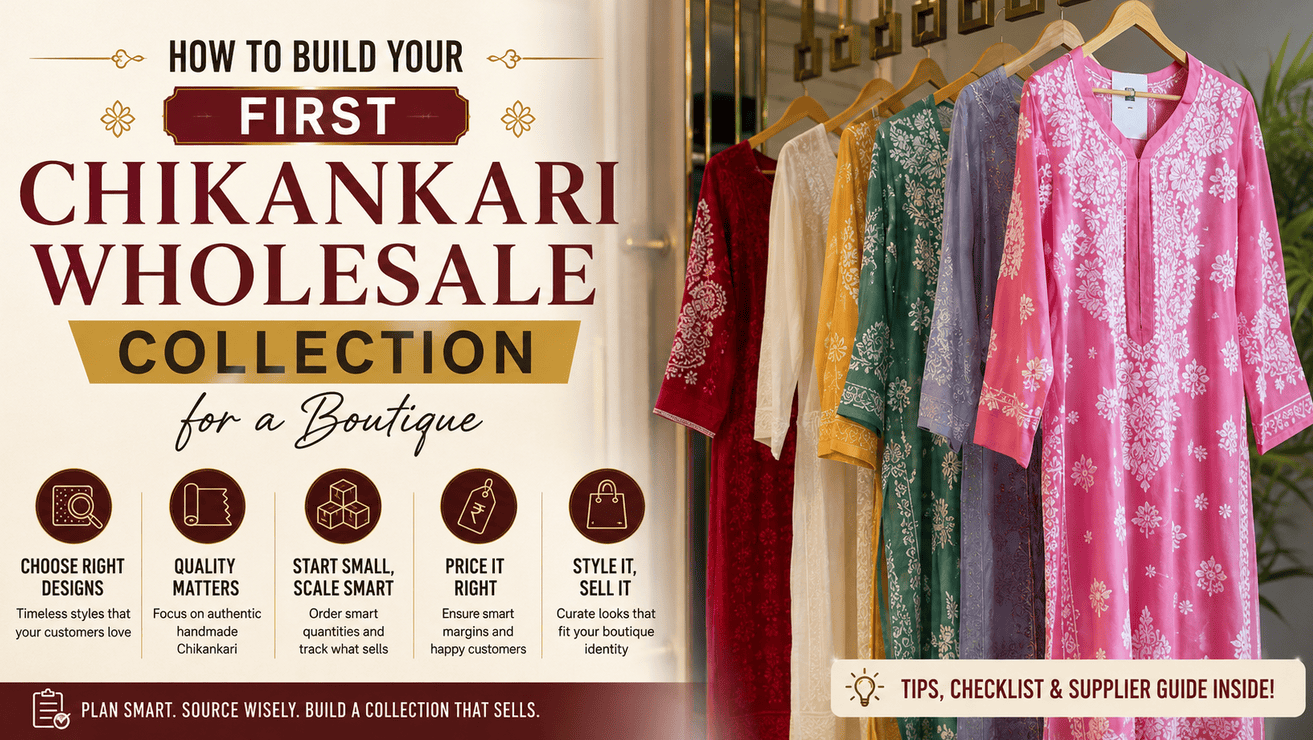
How to Build Your First Chikankari Wholesale Collection for a Boutique
Your first Chikankari wholesale order should not be a random basket of the prettiest designs in a catalogue. It should be a controlled test of what your customer is most likely to buy.
That distinction matters because boutiques rarely fail from having too little choice. They more often struggle when they buy too many disconnected styles, spread the budget too thinly across sizes and colours, or choose products they personally love without a clear link to customer demand.
A strong first assortment has a point of view, but it also gives you useful sales data. It helps you learn which silhouettes, fabrics, price points, colours and sizes deserve deeper investment on the second order.
This guide shows boutique owners how to build that first Chikankari collection step by step.
Quick answer: what should a first Chikankari collection include?
Start with a focused mix of commercial silhouettes, controlled colour variety, a realistic size range and more than one price level. Keep the assortment broad enough to learn what customers want, but not so broad that every style gets only token inventory.
The goal of the first order is not to predict the perfect collection. It is to create a sensible test that generates evidence for the next buy.
Step 1: define the customer before choosing the product
Do not begin with “Which kurtis do I like?” Begin with “Who is buying from my boutique?”
Write down:
- typical customer age range,
- usual spending level,
- everyday vs occasion buying behaviour,
- preferred fits and lengths,
- climate and season,
- whether customers buy complete looks or separates,
- online, offline or mixed sales channel,
- your strongest existing size demand.
If your store already sells Indianwear, use your own sales history. Which kurtas, dresses, co-ords, sarees or suit sets move fastest? Which price points sell without discount? Which sizes sell out first?
That information is more valuable than any generic “best-selling size” list from the internet.
Step 2: choose a collection purpose
A first Chikankari buy becomes easier when it has a job.
Examples:
- Everyday Chikankari: lighter fabrics, easy silhouettes, repeat-wear styling.
- Festive edit: more detailed work, richer fabrics or coordinated sets.
- Summer edit: breathable, lighter-feel products and easy colours.
- Contemporary Chikankari: short kurtas, tops, dresses or co-ords for a younger customer.
- Classic Lucknow edit: traditional silhouettes and a craft-led presentation.
You do not need to force the entire order into one narrow aesthetic. But the customer should understand why the collection belongs together.
Step 3: build an assortment architecture before selecting designs
Assortment planning means deciding what roles products will play before you pick individual SKUs.
A useful first collection can be divided into three commercial roles:
Core products
These are easier-to-understand pieces that can appeal to a broad part of your customer base: straight kurtis, classic kurtas, versatile sets or other proven shapes for your store.
Statement products
These create visual interest and give you content for displays, social media and campaigns. They may have more unusual silhouettes, heavier work or a stronger fashion angle.
Add-on products
These can help increase basket value or give shoppers styling options: dupattas, bottoms, tops or complementary categories depending on your store.
For product discovery, browse the women’s Chikankari wholesale categories and build your assortment around customer need rather than catalogue order.
Step 4: decide breadth vs depth
Breadth means how many different styles you buy. Depth means how many units you hold in each style.
A common first-order mistake is buying too much breadth. Twenty unrelated styles with only one or two useful sizes in each can make the boutique look varied, but it gives you weak sales data and frequent size stockouts.
Too much depth creates the opposite risk: heavy inventory in a product that has not yet proven itself.
Your first order should balance the two. Give important test styles enough size coverage to learn something meaningful, while keeping enough variety to compare silhouettes and fabrics.
Step 5: choose the product mix deliberately
Chikankari can be sold across many silhouettes, including kurtis, kurtas, kurta sets, tops, co-ords, sarees, dupattas, dresses and other categories.
Do not add a category simply because it exists. Add it because your customer has a reason to buy it.
| Category | Useful when your customer wants | Buying question |
|---|---|---|
| Kurtis / kurtas | Versatile everyday or occasion separates | Which lengths and fits already work in my store? |
| Kurta sets | Complete outfits and higher basket value | Does my customer prefer 2-piece or 3-piece looks? |
| Short tops / short kurtas | Contemporary styling and younger wardrobes | Can customers style these with existing bottoms? |
| Co-ord sets | Easy coordinated dressing | Is my customer buying fashion-led sets? |
| Sarees | Occasion, festive or classic craft demand | Does my boutique already have a saree customer? |
| Dupattas / separates | Add-on and styling purchases | Can these increase basket size? |
Step 6: use fabric as a merchandising tool
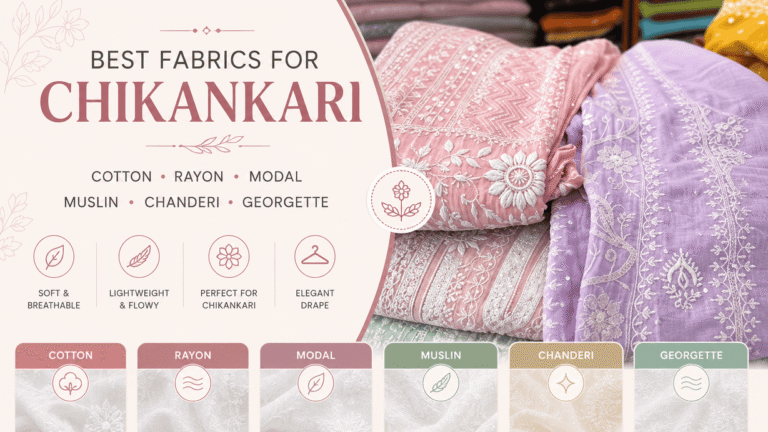
Fabric affects drape, feel, transparency, seasonality, perceived value and the way embroidery looks. It should therefore be part of assortment planning, not an afterthought.
A boutique may deliberately offer a lighter everyday fabric alongside a more elevated occasion fabric so that the collection serves more than one buying moment.
Before selecting, read the best fabrics for Chikankari wholesale buyers comparison and the more detailed Chikankari fabric guide.
Step 7: build a colour strategy instead of buying every colour
Colour variety can make a collection look rich, but it can also fragment your budget.
Think in colour roles:
- Core neutrals: colours that are easier to merchandise repeatedly.
- Seasonal colours: shades that support the current selling period.
- Statement colours: visually strong options that attract attention.
For a first order, avoid ordering every available shade just because it is offered. Too many colour-SKU combinations can leave you with incomplete size runs and make reordering harder to analyse.
Step 8: plan size mix using your own customer data
A size curve is the distribution of your units across sizes. It should not be copied blindly from another boutique.
Use:
- your existing apparel sales,
- customer requests,
- return and exchange history,
- the fit of the specific silhouette,
- your country or regional customer base,
- online vs store behaviour.
If you have no historical data, start conservatively and make sure your first order is capable of teaching you something. Record stockouts as carefully as slow sellers: a size that sells out early can make the remaining sales data misleading.
Use the Chikankari sizing and measurement guide before committing to a size run.
Step 9: create a price ladder
If every piece in your collection sits at the same retail price, customers have fewer ways to enter or trade up within the range.
Instead, think in a simple ladder:
- entry products,
- core products,
- premium or statement products.
The exact pricing will depend on your market and costs. The purpose of the ladder is to give customers choices while helping you compare performance across product types.
Do not calculate retail margin from the supplier price alone. Freight, duties where applicable, payment charges, packaging, local fulfilment, returns, marketplace fees and markdown risk can all affect profitability.
Step 10: decide whether to buy ready stock or develop products
For many first-time buyers, ready stock reduces development complexity. You can test an existing range and gather demand data.
If your boutique already has a strong identity, specific measurements or private-label needs, made-to-order may be more suitable.
Compare the two routes in Ready Stock vs Made-to-Order Chikankari Wholesale.
Step 11: inspect samples like a merchant, not just a customer
When a boutique owner sees a beautiful sample, the natural reaction is emotional. A buyer needs a second layer of analysis.
Ask:
- Will this photograph well?
- Is the fit easy to explain online?
- Does the fabric match my selling season?
- Will customers understand the value at my intended price?
- Can the colour be coordinated with the rest of the assortment?
- Are care requirements suitable for my customer?
- Does the workmanship support my return policy and brand reputation?
For physical checks, use the 25-point Chikankari wholesale quality checklist.
Step 12: create the purchase plan before you request a quote
A supplier can respond more usefully when the buyer sends a clear brief.
Your first-order brief can include:
- buyer type: boutique / online store / multi-brand retailer,
- country and delivery location,
- target product categories,
- preferred fabrics,
- size range,
- approximate quantity,
- ready stock or custom requirement,
- target selling window,
- private-label requirement if any.
You do not need to know every technical detail before enquiring. But the clearer the brief, the easier it is to avoid irrelevant product suggestions.
A practical first-collection worksheet
| Decision | What to write down |
|---|---|
| Customer | Who is most likely to buy? |
| Collection purpose | Everyday, festive, contemporary, classic, seasonal? |
| Categories | Which 2–4 categories matter most? |
| Core vs statement | Which products are commercial anchors? |
| Fabrics | Which feel and season does each fabric serve? |
| Colours | Core, seasonal and statement shades |
| Sizes | Size curve based on actual or test demand |
| Price ladder | Entry, core and premium |
| Quantity | Enough depth to test without overcommitting |
| Reorder trigger | What sales evidence will justify a repeat buy? |
What to track after launch
The first order becomes valuable only if you learn from it.
Track at least:
- sales by style,
- sales by size,
- sales by colour,
- sales by fabric,
- full-price vs discounted sales,
- returns and reasons,
- customer questions,
- stockout dates,
- reorder requests.
Do not judge only on “best seller.” A style that sold 100% because you bought two pieces is not automatically more important than a style that sold 70% of a much deeper buy.
How to plan the second order
Your second order should be less experimental than the first.
Increase depth where demand is clear. Reduce or remove products that needed heavy discounting. Correct the size curve based on sell-through. Repeat colours that earned demand, not simply colours that received compliments.
This is also the point where a boutique may move selected winners into a custom or private-label conversation.
Common first-order mistakes
Buying for yourself
Your personal taste can shape the boutique, but the customer funds it. Use sales evidence whenever available.
Too many styles, too little depth
A wide catalogue can look exciting but produce incomplete size availability almost immediately.
Ignoring fit differences between silhouettes
Do not apply one size assumption to straight kurtas, fitted tops, oversized styles and bottoms.
Overcommitting to a festival or trend
Seasonal demand can be strong but time-sensitive. Consider how leftover stock will sell after the event.
Buying only on wholesale price
The cheapest piece is not the most profitable if it has poor sell-through, high returns or weak customer perception.
How ChikankariWholesale.com can support a boutique buy
ChikankariWholesale.com is structured for business buyers who want to compare categories, understand fabrics, evaluate samples and move into wholesale ordering with clearer requirements.
Start with the Chikankari wholesale for boutiques page, then review the wholesale catalogue. When you know the categories and approximate quantity you want to test, request a wholesale quote.
Frequently asked questions
How many styles should a first Chikankari collection have?
There is no universal number. It depends on budget, store size, category mix and how much depth each style needs. The key is avoiding so many styles that you cannot maintain useful size coverage or learn meaningful sell-through.
Should a new boutique start with kurtis only?
Not necessarily. Kurtis may be commercially useful, but the right mix depends on your customer. A store with strong occasion demand may need sets or sarees; a younger online audience may respond to short kurtas, tops or co-ords.
How do I choose colours without sales history?
Use a controlled test across core, seasonal and statement shades rather than ordering every colour. Track sales and customer requests so the second order can be more data-driven.
Should I private label my first order?
Only if private label is central to your brand and the commercial conditions make sense. If you are still validating the customer and product, ready-stock wholesale can be a simpler way to learn first.
What is the most important number to track?
No single metric tells the whole story. Style sell-through, size stockouts, full-price sales, returns and weeks of supply together give a more useful picture of assortment quality.
Final takeaway
Your first Chikankari collection is not the final answer. It is the beginning of a buying system.
Define the customer, control the assortment, plan sizes and price levels, test with enough depth to learn, and let actual sales shape the next order. That is how a boutique moves from “buying beautiful products” to building a repeatable Chikankari business.