How to Source Chikankari from India for the USA, UK, Canada, UAE & Australia
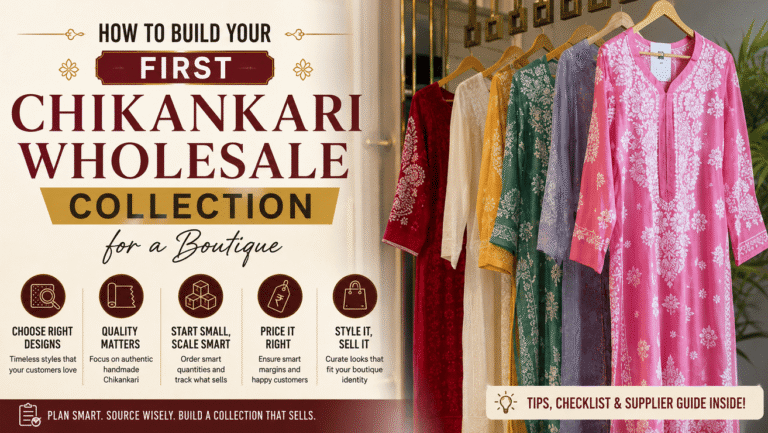
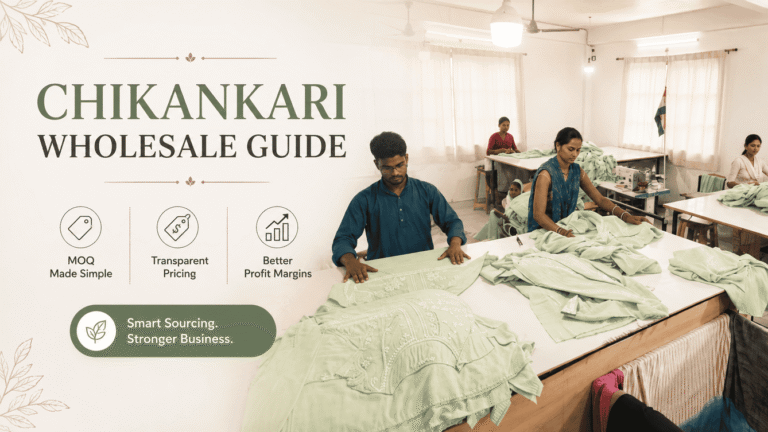
Sourcing Chikankari from India can give boutiques, retailers, ecommerce sellers and fashion brands access to a much wider selection of Lucknowi embroidered garments than they may find locally. But international wholesale buying has more moving parts than choosing a design from a catalogue.
A successful order needs the right supplier, clear product specifications, size planning, fabric and embroidery checks, realistic landed-cost calculations, accurate textile labels, export documentation and a shipping method that fits the value and urgency of the order.
This guide explains a practical sourcing workflow for buyers in the USA, UK, Canada, UAE and Australia. It is written for business buyers, not personal shoppers, and focuses on the checks that reduce risk before money is committed to a bulk order.
Quick answer: what is the safest way to source Chikankari from India?
Start with a clear buying brief. Shortlist a Lucknow-based supplier or manufacturer, verify the product and embroidery method, request detailed measurements and composition information, sample when the order justifies it, agree the commercial specification in writing, calculate your landed cost, confirm destination-country labelling and import requirements, and only then approve bulk production or dispatch.
The goal is not simply to find the lowest Indian wholesale price. It is to receive a sellable product that arrives with the right specification, documentation and cost structure for your market.
Why Lucknow matters when sourcing Chikankari
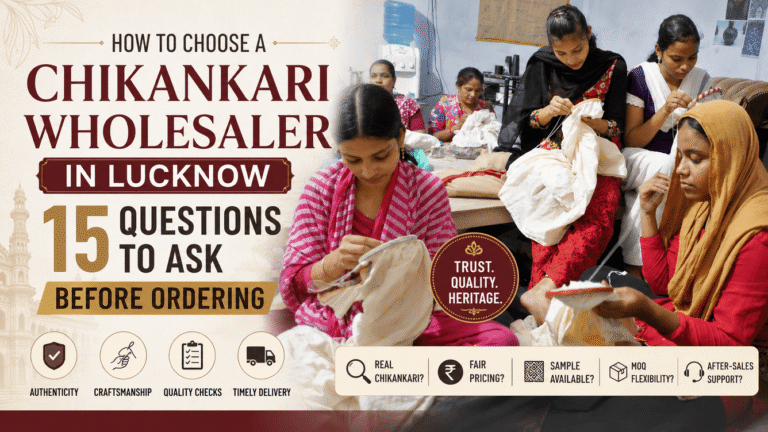
Lucknow is the city most closely associated with Chikankari. For buyers who want to source closer to the craft and its production ecosystem, working with a Lucknow-based business can make supplier conversations more specific around embroidery, fabrics, finishing and product development.
ChikankariWholesale.com handles B2B enquiries from Lucknow and provides separate sourcing paths for ready stock, wholesale buying, custom development and private label. Start with the Chikankari manufacturer in Lucknow page if you are comparing manufacturing partners.
Step 1: build your sourcing brief before contacting suppliers
A vague enquiry such as “send best price” usually produces a vague answer. A professional sourcing brief should include:
- product category: kurti, kurta, kurta set, co-ord, saree, dupatta, menswear or fabric,
- approximate quantity,
- target sizes,
- preferred fabric,
- embroidery or work expectation,
- ready stock versus custom production,
- private-label requirements if any,
- target delivery market,
- target retail or landed-cost range if useful,
- desired timeline.
This makes it much easier for a supplier to tell you what is feasible.
Step 2: verify what kind of Chikankari you are buying
International customers often attach strong value to words such as handmade, artisan-made and authentic. Your supplier should therefore be able to explain the embroidery method used on the products you intend to sell.
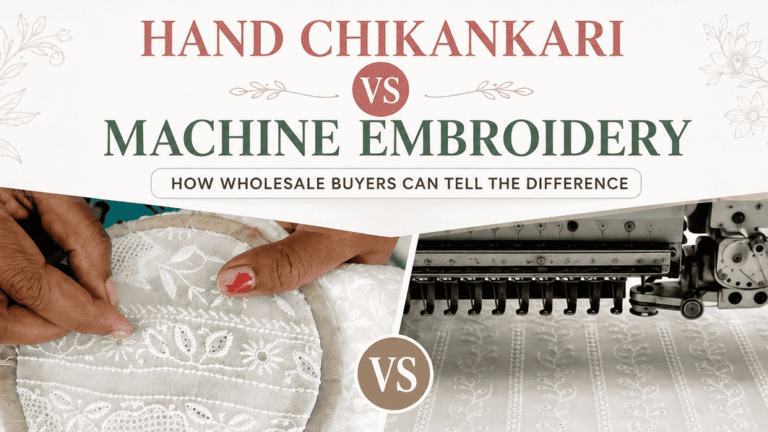
Ask whether the work is hand embroidered, machine embroidered or a mixed process. Inspect close-ups, reverse-side photographs and samples where necessary. If you plan to market a product as hand embroidered, do not rely on appearance alone.
Use the authentic Chikankari guide and our detailed Chikankari stitches guide during supplier evaluation.
Step 3: confirm fabric composition, not just the fabric nickname
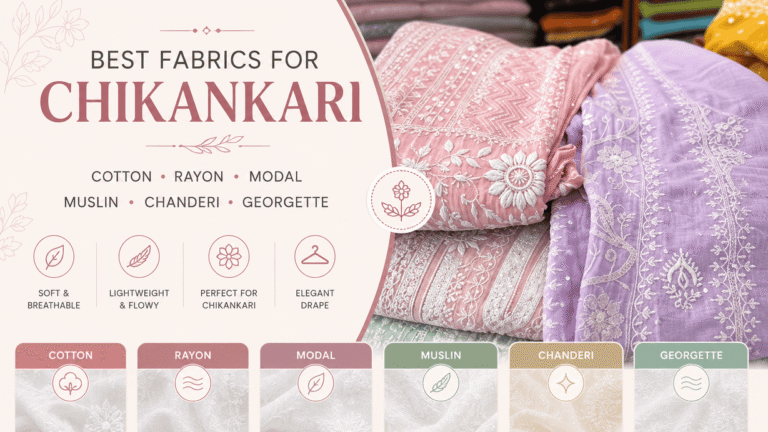
International textile rules and customer expectations make composition especially important. “Chanderi,” “muslin,” “modal” or “georgette” may describe the commercial fabric direction, but your product documentation should reflect the actual fibre content supplied.
Before placing the order, confirm:
- fibre composition,
- fabric weight or feel where relevant,
- lining composition,
- bottom and dupatta composition in sets,
- care instructions,
- colourfastness and shrinkage expectations.
Our fabric guide for wholesale buyers can help you compare cotton, rayon, modal, muslin, Chanderi and georgette-based products.
Step 4: treat sizing as a market-localisation decision
One of the most common international buying mistakes is assuming that an Indian size label automatically matches what a US, UK, Canadian or Australian customer expects.
Do not buy only by XS, S, M, L or XL. Ask for garment measurements.
Important measurements can include:
- bust,
- waist,
- hip,
- shoulder,
- sleeve length,
- kurta length,
- armhole,
- bottom waist and hip,
- bottom length.
Then map those measurements to your own store’s size chart. Read the Chikankari sizing and measurement guide before approving a size run.
Step 5: sample strategically
A physical sample is particularly valuable when you are buying from another country because returning an unsuitable bulk order can be expensive and slow.
A sample can help you check:
- embroidery quality,
- fabric feel,
- colour,
- measurements,
- construction,
- lining and opacity,
- finishing,
- how the product photographs,
- how it fits your local customer.
For custom or private-label orders, the approved sample should become the reference point for bulk production. Use the sample request page when your order needs physical evaluation.
Step 6: calculate landed cost before you approve the order
The Indian wholesale price is only one part of the commercial calculation.
Landed Cost = Product Cost + Export/Inbound Freight + Insurance where applicable + Import Duty + Taxes + Brokerage/Clearance + Local Delivery + Direct Labelling/Packaging Costs
Actual duties and taxes depend on the destination, tariff classification, shipment value and local rules. Do not use a generic percentage from a social-media post as your final calculation.
For larger orders, ask your customs broker, freight forwarder or accountant to confirm the likely treatment before the goods leave India.
Step 7: agree Incoterms and responsibility clearly
International quotations can become confusing when buyer and seller assume different responsibilities for freight, insurance and customs clearance.
Ask the supplier to state what the quote includes. For example, does the price cover only the goods, delivery to the carrier in India, international freight, or delivery to your address?
You do not need to become a logistics expert, but you do need a written understanding of who is paying for each stage.
Step 8: confirm export documentation
Commercial shipments can require documentation such as a commercial invoice, packing list and transport documents, with additional paperwork depending on the product, shipment and destination.
ChikankariWholesale.com has a dedicated export documentation and customs guide for B2B buyers. Final requirements should always be checked for the actual shipment rather than assumed from a previous order.
Step 9: check textile labels for your destination country
Textile labelling rules are not identical across markets. Fibre content, country of origin, dealer identity, care information and language requirements may differ depending on where you sell.
This becomes especially important for private-label buyers because your brand may become responsible for the retail-facing label.
Sourcing Chikankari for the USA
US buyers should pay close attention to fibre-content and country-of-origin labelling. The US Federal Trade Commission provides guidance under the Textile Fiber Products Identification Act and related textile rules. Depending on the product, labels can need information such as fibre content, country of origin and the responsible company identity.
Before placing a branded order, review current FTC textile labelling guidance and confirm customs classification with your broker. Do not assume that a supplier’s Indian retail label automatically satisfies US requirements.
For market-specific sourcing considerations, see our Chikankari wholesale USA page.
Sourcing Chikankari for the UK
UK textile products generally need fibre-content labelling, and businesses should ensure descriptions match the actual composition. Import VAT, customs duty and the correct commodity code can also affect landed cost.
UK government guidance on textile labelling and importing goods should be checked before shipment, particularly if you are importing commercially for resale.
See our Chikankari wholesale UK page for a buyer-focused overview.
Sourcing Chikankari for Canada
Canadian textile labelling requirements can include fibre-content and dealer information, with specific rules administered under Canada’s textile labelling framework. Bilingual presentation may also matter depending on the information and market context.
Importers should confirm the current Competition Bureau and Canada Border Services Agency requirements that apply to their products before approving final labels or commercial shipments.
Use our Chikankari wholesale Canada page as the commercial starting point.
Sourcing Chikankari for the UAE and GCC
UAE buyers often source Indian ethnicwear for boutiques, ecommerce and regional distribution, but customs procedures, importer registration and product documentation can depend on the emirate and business setup.
Before shipping, confirm the requirements with your local customs broker or relevant customs authority, including any labelling or conformity requirements that apply to your product category.
See our Chikankari wholesale UAE & GCC page for market-specific sourcing information.
Sourcing Chikankari for Australia
Australian buyers should check current consumer-product and textile requirements, including care-labelling obligations where applicable, along with customs and GST treatment for imported goods.
The Australian Competition and Consumer Commission and Australian Border Force are appropriate starting points for current regulatory information. For commercial planning, see our Chikankari wholesale Australia page.
Step 10: choose shipping by value, volume and urgency
There is no single best shipping method for every wholesale order.
Courier / express
Often useful for samples and smaller or time-sensitive shipments. It can be faster and easier to track, but cost per kilogram can be higher.
Air freight
Can make sense for larger commercial shipments where speed still matters. Freight-forwarder handling and customs clearance need to be planned.
Sea freight
Can suit larger-volume orders where transit time is less critical, but the shipment has more logistics stages and may not be economical for modest quantities.
Compare freight quotes using chargeable weight, carton dimensions, destination charges and clearance fees, not only the headline international freight rate.
Read the Chikankari wholesale shipping and export guide before choosing a method.
Step 11: plan packaging for international transit
Garments can spend days moving through hubs, customs facilities and delivery networks. Good packaging protects against moisture, crushing and handling damage while keeping carton dimensions commercially sensible.
For private-label orders, confirm whether products need individual bags, size stickers, barcode labels, hangtags or other retail preparation before dispatch.
Step 12: understand ready stock versus custom manufacturing
International first-time buyers often benefit from testing ready stock before moving into deeper custom development. It can help you learn which fabrics, colours, silhouettes and sizes work in your market.
Custom manufacturing becomes more useful when you have clearer demand data and want your own measurements, colourways, labels or product direction.
Compare ready-stock Chikankari wholesale with private-label Chikankari manufacturing before choosing the sourcing route.
Step 13: create a clear quality standard for bulk production
For repeatable B2B buying, define quality in measurable terms. Your supplier and your team should be checking the same things.
A basic QC brief can cover:
- approved fabric and colour,
- embroidery type and placement,
- measurements and tolerance,
- stitching quality,
- stains and fabric defects,
- thread trimming,
- lining and opacity,
- set completeness,
- labels and packaging.
Use the Chikankari quality control guide to structure inspection expectations.
Step 14: think about reorders before placing the first order
A product that sells well is valuable only if you understand whether and how it can be replenished.
Ask:
- Is this design ready stock only?
- Can the fabric be sourced again?
- Can the same embroidery be repeated?
- Will colours vary between production lots?
- What information should I quote when reordering?
Keep supplier style references, approved images and specifications organised. This makes repeat ordering much faster.
Step 15: use a written purchase specification
For meaningful commercial orders, WhatsApp pictures alone are not enough. Your final confirmation should make the important details explicit.
Record product reference, quantity, size ratio, colour, fabric, embroidery, measurements, labels, packaging, agreed price, shipping terms, payment terms and any approved sample reference.
The more precise the order, the fewer avoidable disputes you are likely to have later.
International sourcing checklist
- Define product category and quantity.
- Verify supplier and Lucknow sourcing context.
- Confirm embroidery method.
- Confirm exact fabric composition.
- Map garment measurements to your local size chart.
- Approve a sample where appropriate.
- Calculate landed cost.
- Check destination textile-labelling rules.
- Confirm customs classification and import requirements.
- Agree shipping responsibility.
- Confirm export documents.
- Plan packaging and private labels.
- Create QC standards.
- Record the final purchase specification.
- Plan how successful styles will be reordered.
Common mistakes international Chikankari buyers should avoid
Buying only from catalogue photos
Photos are useful for design selection but cannot fully show fabric hand-feel, inside finishing, measurements or embroidery method.
Comparing only unit price
A low product price can become expensive after freight, duty, taxes, poor sell-through or quality problems. Compare landed cost and sellability.
Assuming Indian and local sizing are identical
Always buy from measurements rather than size letters alone.
Leaving labels until after production
Private-label buyers should confirm destination-market requirements before labels are printed and attached.
Using unverified “handmade” claims
Your retail product description should accurately reflect how the item was produced.
Ignoring reorder feasibility
Ask about repeatability before a style becomes a bestseller.
How ChikankariWholesale.com supports international B2B sourcing
ChikankariWholesale.com gives international buyers a structured starting point for sourcing authentic Lucknow Chikankari across ready-stock, wholesale, custom and private-label requirements. Buyers can review product categories, fabric and embroidery information, samples, sizing, quality control, shipping and export considerations before requesting a quotation.
If you already know what you need, request a Chikankari wholesale quote with your country, buyer type, product category, approximate quantity, sizes and sourcing requirements.
Frequently asked questions
Can I buy Chikankari wholesale directly from India?
Yes, international businesses can source from Indian suppliers, subject to the supplier’s commercial terms and the import rules in the destination country. Buyers should confirm product specifications, labels, customs documentation, landed cost and local regulatory requirements before shipping.
Should I source Chikankari from Lucknow?
Lucknow is closely associated with the Chikankari craft and is a logical sourcing location for buyers seeking specialist suppliers and manufacturers. Location alone does not guarantee quality, so you should still verify the product, embroidery, fabric, sample and commercial terms.
What is the best way to pay an Indian Chikankari supplier?
Use the payment methods formally offered by the supplier and make sure the beneficiary details match the contracting business. Payment terms vary by ready stock, production, custom development and order value, so they should be confirmed in the quotation or invoice.
How do I know what import duty I will pay?
Duty depends on the destination country, product classification, declared value and current customs rules. Ask a licensed customs broker or the relevant customs authority to confirm the tariff treatment for your actual products.
Can Chikankari products be private labelled for international boutiques?
Private-label requirements can be evaluated according to the product, quantity, labels, packaging and production feasibility. Buyers should provide the destination country early so labelling requirements can be considered before production is finalised.
Should international buyers request samples?
For a meaningful bulk or custom order, sampling can significantly reduce sourcing risk. It allows you to check embroidery, fabric, sizing, construction and finishing before a larger commitment.
Final takeaway
International Chikankari sourcing works best when you treat it as a supply-chain decision, not just a catalogue purchase. The right supplier is important, but so are the measurements, fibre composition, labels, landed cost, customs documentation, shipping plan and quality standard behind the order.
Build those checks into the first order and future reorders become much easier. When you are ready, send your international wholesale requirement to ChikankariWholesale.com with your country, product category and approximate quantity.