Chikankari Wholesale MOQ, Pricing & Profit Margins: A Guide for Boutiques and Resellers
One of the first questions a boutique owner or reseller asks when sourcing Chikankari is simple: what is the wholesale price? But a useful answer needs more context. The price of a Chikankari garment can change with fabric, embroidery, silhouette, quantity, finishing, customisation, packaging and whether the order is ready stock or made for you.
The second question is usually about MOQ, or minimum order quantity. The third is the one that decides whether the purchase makes business sense: what margin can I realistically make after all costs?
This guide explains how to evaluate Chikankari wholesale MOQ and pricing without relying on misleading “lowest price” comparisons. It also gives you a simple framework for calculating landed cost and planning your own retail margin.
Quick answer: what should a buyer compare?
Do not compare only the unit price quoted by two suppliers. Compare the landed cost of a sellable unit: product cost, taxes where applicable, packaging, shipping, duties for international orders, payment charges, expected defects or claims, and any additional labelling or finishing you require.
Then compare that landed cost with the realistic selling price in your market. That gives you a much better picture of margin than a wholesale price alone.
What does MOQ mean in Chikankari wholesale?
MOQ means minimum order quantity: the smallest quantity a supplier is willing to accept for a particular type of order.
There is no universal Chikankari MOQ. It can vary by:
- ready-stock versus fresh production,
- product category,
- design, colour and size mix,
- fabric availability,
- custom manufacturing,
- private-label requirements,
- embroidery complexity,
- packaging and finishing.
On ChikankariWholesale.com, MOQ is confirmed according to the specific sourcing route and buyer brief rather than assumed as one number for every product. You can review the dedicated MOQ, pricing and samples guide before requesting a quote.
Ready stock and production orders have different economics
Ready stock
Ready stock can be useful for boutiques testing a category, resellers that need faster replenishment, and buyers who want to reduce product-development risk. The trade-off is that your size, colour and quantity options depend on what is currently available.
For new buyers, ready stock can make it easier to test sell-through before committing to a larger custom production.
Fresh production
Production orders can offer more control over specification, but they may require higher commitment because fabric, embroidery, cutting and finishing have to be planned for the order.
When customisation or private label is involved, MOQ can also be affected by labels, packaging, colour development or other components.
Compare the two sourcing routes on our ready-stock Chikankari wholesale page and custom manufacturing page.
What affects Chikankari wholesale pricing?
Wholesale pricing should make sense when you break the garment into its commercial components. The main factors usually include the following.
1. Base fabric
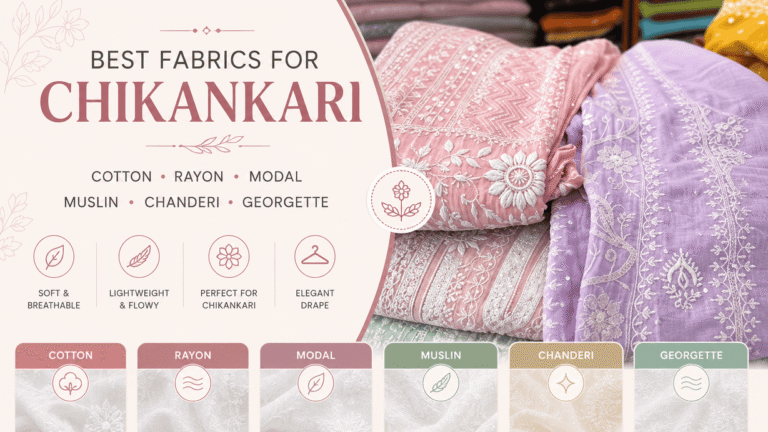
Cotton, rayon, modal, muslin, Chanderi, georgette and other bases can sit at very different cost levels depending on quality, composition and finish.
2. Embroidery type and density
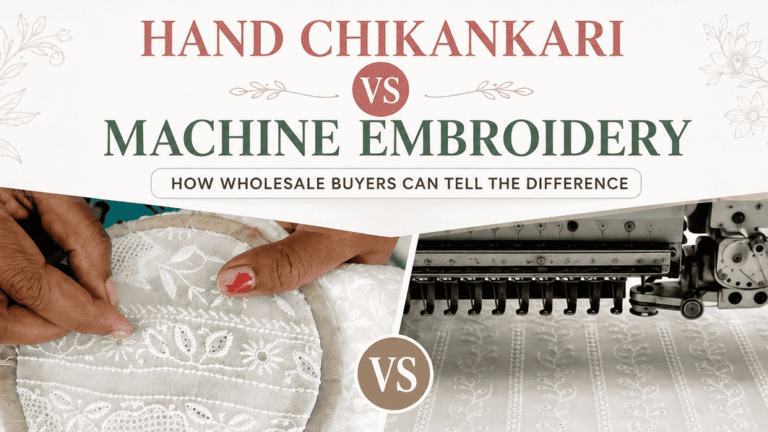
A lightly worked motif and a dense embroidered front or all-over jaal are not equivalent. Handwork, machine work, mixed processes, stitch complexity and embroidery coverage all influence production cost.
3. Garment construction
A simple straight kurti generally has fewer components than a three-piece kurta, pant and dupatta set. Linings, gathers, panels, complex sleeves, farshi bottoms or special finishing can add labour and material.
4. Quantity
Quantity can influence pricing because cutting, fabric procurement, embroidery planning, packaging and other production steps may become more efficient at certain volumes. Do not assume that every supplier uses the same quantity slabs; ask for the exact quote for your requirement.
5. Customisation
Changes in colour, measurements, embroidery, labels, tags, packaging or design can affect cost. A customised order should be priced from an agreed specification rather than compared directly with a ready-stock catalogue item.
6. Finishing and quality control
Thread trimming, washing where applicable, ironing, measurement checks, stain checks, packing and final inspection all have a cost. A cheaper quote can become expensive if weak finishing creates returns or customer complaints.
Wholesale price is not the same as landed cost
This is where many new resellers make their first expensive mistake.
If a supplier quotes a garment at a certain unit price, that does not necessarily represent the amount the product costs you by the time it is ready for sale.
Simple landed-cost formula
Landed Cost per Sellable Unit = Product Cost + Inbound Shipping + Duties/Taxes + Packaging/Labelling + Payment/Transaction Costs + Other Direct Sourcing Costs
For international buyers, customs and import taxes can materially change the final number. For domestic buyers, freight, GST treatment, packaging or marketplace preparation may be relevant depending on your business setup.
Use actual quotations and your own tax/accounting advice for final calculations.
How to calculate gross margin on a Chikankari product
Once you know your landed cost and realistic selling price, you can calculate gross margin.
Gross Margin % = (Selling Price − Cost of Goods Sold) ÷ Selling Price × 100
For example, if your final sellable-unit cost is represented as C and your selling price as S, the gross margin is (S−C)/S. This is different from simply marking the cost up by a percentage.
Your true business profit will still need to cover expenses such as advertising, marketplace fees, payment gateway charges, warehousing, salaries, returns, discounts and overheads. Therefore, a product with an attractive gross margin is not automatically a highly profitable product.
Markup and margin are not the same thing
This distinction matters when comparing wholesale opportunities.
Markup measures profit relative to cost. Margin measures gross profit relative to selling price.
A buyer who says “I add 50%” may be describing markup, not a 50% gross margin. Use one method consistently when comparing products so you do not overestimate profitability.
What selling price should a boutique use?
There is no universal retail multiplier for Chikankari. Your market determines what customers will actually pay.
Consider:
- your customer profile,
- competitor retail prices,
- fabric and embroidery quality,
- product photography and presentation,
- brand positioning,
- online marketplace fees,
- promotional discounting,
- international duties and shipping,
- expected return rate,
- how quickly the product is likely to sell.
A lower-cost item that needs constant discounting can be less profitable than a better product that sells closer to full price.
Build a margin buffer for discounts
Many retailers calculate margin using the full ticket price but then sell a large share of inventory during promotions. That can distort buying decisions.
Before ordering, test at least three scenarios:
- full-price sale,
- normal promotional sale,
- clearance or slow-moving sale.
If the product only works financially at full price, you have very little room for marketing or inventory risk.
Think in terms of sell-through, not just unit margin
High unit margin does not help if most of the stock remains unsold.
A useful buying decision considers both:
- margin per sold unit, and
- probability of selling through the quantity purchased.
This is why assortment planning matters. A boutique might prefer to test multiple designs in controlled quantities rather than put too much capital into one style before customer demand is proven.
Our Chikankari wholesale guide for boutiques covers this buyer perspective in more detail.
How MOQ can affect inventory risk
A higher MOQ can reduce unit cost in some cases, but it also ties up more cash in inventory. The cheapest unit price is not automatically the lowest-risk buying decision.
Before accepting a larger quantity to obtain a better quote, estimate:
- how many units you can realistically sell per month,
- how long the stock may take to turn,
- which sizes usually move fastest,
- how much capital will remain blocked in slow sizes,
- whether the style is seasonal,
- whether the design can be reordered later.
A small difference in unit price can be less important than cash-flow flexibility.
Should you mix sizes and designs within an MOQ?
This depends on the supplier and order type. Some ready-stock buying models may allow a mixed assortment; production orders may have minimums by design, colour or size because components are planned specifically for the order.
Do not assume. Ask the supplier exactly how MOQ is defined:
- per order,
- per design,
- per colour,
- per size,
- or per production specification.
This one question can change the amount of inventory risk in your first order.
Sample cost should be viewed as risk control
A sample may feel like an extra cost when you are trying to protect margin, but for a serious production order it can prevent a much larger mistake.
A physical sample can help you check:
- fabric feel,
- embroidery quality,
- colour,
- measurements,
- construction,
- lining,
- finishing,
- how the garment photographs.
See the Chikankari sample request page if you want to evaluate a specification before moving into larger quantities.
How to compare two Chikankari wholesale quotes properly
| Compare | Why It Matters |
|---|---|
| Exact fabric | Different qualities can look similar in a catalogue but perform differently |
| Embroidery method | Hand, machine and mixed work are not directly comparable |
| Embroidery density | Coverage can significantly change cost and perceived value |
| Garment specification | Length, lining, bottom, dupatta and construction affect cost |
| MOQ definition | A low price may require higher commitment per design or colour |
| Sample terms | Important for reducing quality risk |
| Packaging | Retail-ready or private-label packing can add cost |
| Shipping | A lower ex-factory price may have higher freight impact |
| Claims policy | Defect handling affects effective cost |
| Repeatability | Reordering winners can be more valuable than one cheap purchase |
Red flags in unusually cheap wholesale offers
A low quote is not automatically bad, but investigate it if the price looks disconnected from the specification.
Ask whether the quote has changed because of:
- different fabric quality,
- lighter embroidery,
- machine rather than hand work,
- shorter garment length,
- no lining,
- different bottom or dupatta fabric,
- lower finishing standard,
- larger MOQ,
- old or clearance inventory.
The correct comparison is like-for-like.
Private label changes the costing conversation
If you are sourcing for your own brand, include all brand-specific costs before calculating margin. Labels, hangtags, custom packaging, size stickers, barcode labels, custom measurements or product development can alter the economics.
Review the private-label Chikankari manufacturing page when planning branded orders.
International buyers: calculate landed cost before approving the order
Importers should not wait until dispatch to think about duties and documentation. Shipping mode, chargeable weight, customs valuation, local taxes, brokerage and labelling requirements can change the cost of a garment substantially.
Use our wholesale shipping and export guide and confirm destination-specific requirements with your customs or tax professional.
A simple pre-order profit check
- Confirm the exact wholesale unit cost.
- Add shipping and all direct sourcing costs.
- Add any duty or import tax relevant to your market.
- Add labels, packaging and marketplace preparation.
- Estimate expected promotional selling price, not only MRP.
- Calculate gross margin at that selling price.
- Subtract marketplace or payment fees where relevant.
- Stress-test the margin at a deeper discount.
- Estimate sell-through by size and design.
- Only then decide whether the MOQ makes sense.
How ChikankariWholesale.com approaches wholesale enquiries
ChikankariWholesale.com is designed for B2B buyers who need more than a single public price. A useful quotation begins with the product category, quantity, fabric, embroidery or work requirement, sizing, customisation, destination and timeline.
This allows boutiques, retailers, resellers, ecommerce sellers, importers and fashion brands to compare the correct specification rather than making decisions from an incomplete headline price.
Browse the wholesale catalogue or go directly to the wholesale quote request when you have your requirement ready.
Frequently asked questions
What is the MOQ for Chikankari wholesale?
There is no universal MOQ for all Chikankari orders. Minimum quantities can vary by ready stock, product, design, colour, customisation and private-label requirements. Ask for the MOQ that applies to the exact order you are considering.
Why do Chikankari wholesale prices vary so much?
Differences in fabric, embroidery method, embroidery density, garment construction, quantity, finishing, customisation and packaging can all change the unit price. Compare full specifications rather than product names alone.
What is a good profit margin for a Chikankari boutique?
There is no single correct margin because rent, advertising, marketplace fees, returns, discounting and customer acquisition costs vary by business. Calculate the gross margin from your own landed cost and realistic selling price, then make sure it leaves enough room to cover operating expenses.
Should I choose the supplier with the lowest wholesale price?
Not automatically. Compare landed cost, quality, MOQ risk, repeatability, defect handling, shipping and sell-through potential. A slightly higher unit cost can be more profitable if the product sells better and creates fewer returns.
How can I request Chikankari wholesale pricing?
Send the supplier your product category, expected quantity, sizes, fabric or embroidery preference, customisation needs and destination. A detailed brief makes the quote more useful and easier to compare.
Final takeaway
Chikankari wholesale buying becomes much clearer when you separate three different questions: What is the MOQ? What is the landed cost? What margin remains at the price I can realistically sell at?
Do that calculation before you chase the cheapest quote. The objective is not to buy the lowest-cost garment; it is to buy an assortment that can sell reliably, protect your cash flow and leave enough margin to operate your business.
Ready to compare a real requirement? Request a Chikankari wholesale quote with your product category, quantity, destination and sourcing brief.