Best Fabrics for Chikankari: Cotton, Rayon, Modal, Muslin, Chanderi & Georgette Compared
Choosing the right fabric for Chikankari is not just a design decision. For a wholesale buyer, the base fabric affects how the embroidery looks, how the garment falls, how easy it is to sell, what price bracket it can sit in and how suitable it is for different climates and customer groups.
Cotton, rayon, modal, muslin, Chanderi and georgette can all work with Chikankari, but they do not behave the same way. A boutique buying lightweight everyday kurtis has different needs from a retailer building a festive three-piece range or an international seller looking for easy-to-ship occasionwear.
This guide compares the most commonly requested fabric directions from a buyer’s perspective so you can make a better assortment decision before placing a wholesale order.
Quick answer: which fabric is best for Chikankari?
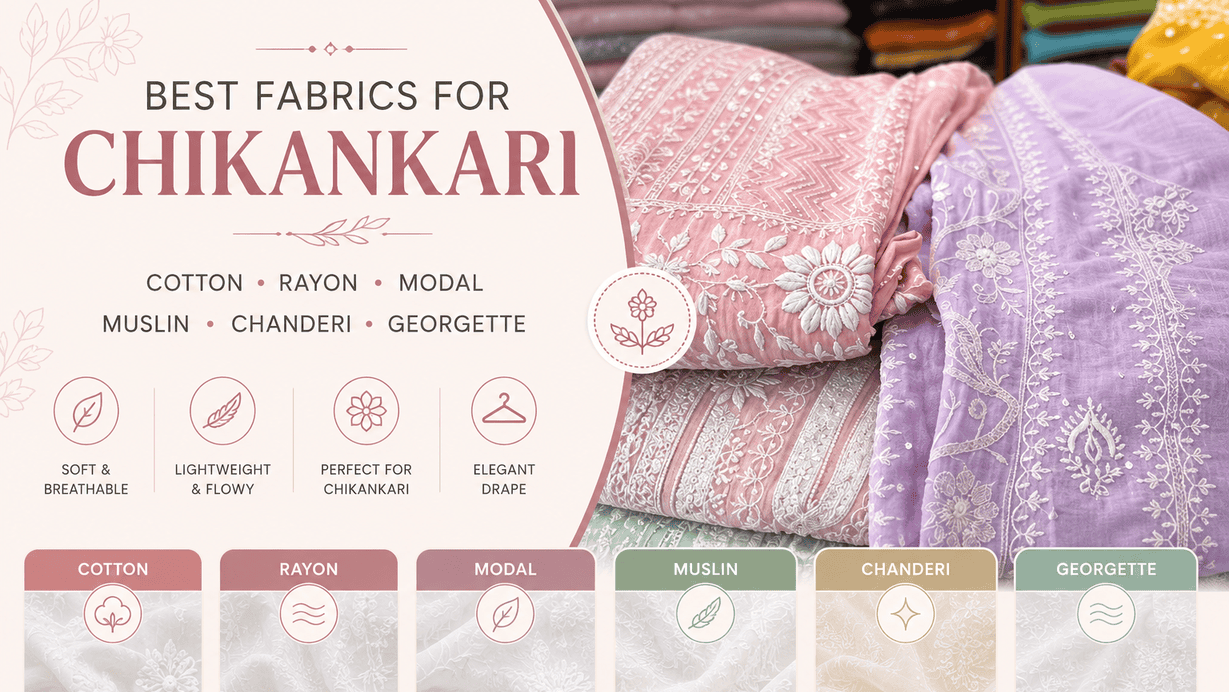
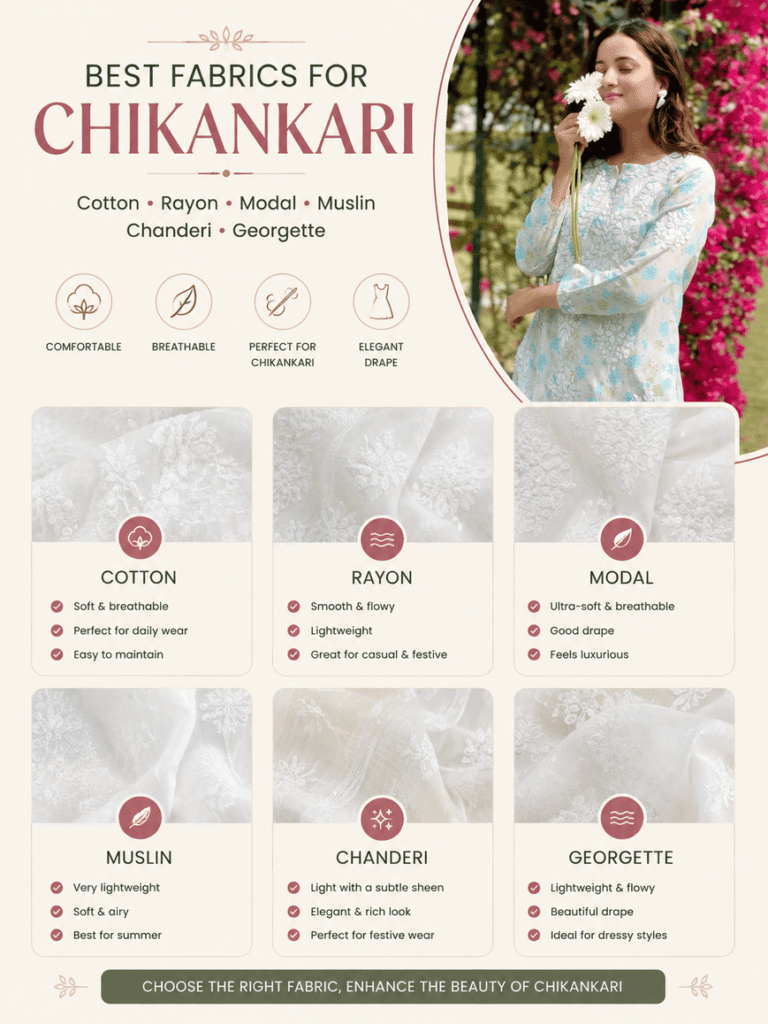
There is no single best fabric for every Chikankari product. Cotton is a dependable choice for breathable everyday wear, rayon offers a soft drape and accessible commercial feel, modal suits fluid premium-casual silhouettes, muslin works well for lightweight elevated styles, Chanderi is often chosen for a more festive or dressy appearance, and georgette can work especially well for flowy occasionwear and sarees.
The best fabric is the one that matches your customer’s climate, price point, silhouette and care expectations.
Chikankari fabric comparison for wholesale buyers
| Fabric | Typical Feel | Best Suited To | Buyer Consideration |
|---|---|---|---|
| Cotton | Breathable, familiar, natural-feeling | Everyday kurtis, kurtas, summer assortments | Check weight, opacity and shrinkage expectations |
| Rayon | Soft, fluid, smooth | Value-led kurtis, long kurtas, palazzo sets | Check drape, colour fastness and recovery |
| Modal | Very soft, fluid, refined | Premium-casual kurtas, palazzos, contemporary silhouettes | Check handle, stretch behaviour and care instructions |
| Muslin | Lightweight, airy, elegant | Kurta sets, dupatta sets, elevated daywear | Check transparency, lining need and fabric strength |
| Chanderi | Light, crisp, slightly lustrous | Festive sets, occasion kurtas, dupattas | Check sheerness, lining and weave consistency |
| Georgette | Flowy, textured, drapey | Sarees, anarkalis, dupattas, occasionwear | Check snagging, lining, weight and finish |
These are broad buyer-side characteristics. Exact performance depends on fibre composition, weave, GSM, finish and the specific embroidery used. Always verify the actual fabric specification for the product you are buying.
1. Cotton for Chikankari
Cotton is one of the most commercially useful base fabrics for Chikankari because customers already understand it. It is breathable, familiar and particularly easy to position for daily wear, warm-weather wardrobes and classic Lucknowi styling.
Where cotton works best
- everyday Chikankari kurtis,
- straight kurtas,
- summer collections,
- white-on-white styles,
- casual boutique assortments,
- customers who prioritise breathable natural-feeling fabrics.
What wholesale buyers should check
Not all cotton is the same. Ask about fabric weight, transparency, softness, shrinkage behaviour, colour fastness and whether the garment is pre-washed or requires special care. Dense embroidery on a very lightweight cotton may affect drape, while a heavier cotton may feel more structured.
If you are building a core everyday assortment, cotton is often a sensible starting point because the customer proposition is easy to explain.
2. Rayon for Chikankari
Rayon is widely used in commercial ethnicwear because it combines softness, drape and an accessible hand-feel. It can make long kurtas and palazzo sets feel fluid without requiring a very heavy fabric.
Where rayon works best
- long straight kurtas,
- short kurtis,
- palazzo sets,
- everyday-to-dressy transitional styles,
- collections where drape matters.
What wholesale buyers should check
Check how the fabric behaves after washing, whether colours bleed, how easily it wrinkles and whether the garment retains its shape. Some rayon qualities can feel substantially better than others, so do not buy on the fibre name alone.
For wholesale buying, sample the exact fabric quality because “rayon” by itself tells you very little about final product feel.
3. Modal for Chikankari
Modal has become popular for Chikankari products that need a softer, more fluid and slightly more premium casual feel. It often works especially well in palazzos, long kurtas and contemporary silhouettes.
Where modal works best
- fluid straight kurtas,
- palazzos and bottoms,
- premium everyday wear,
- contemporary Chikankari separates,
- soft drape-focused collections.
What wholesale buyers should check
Look at fabric recovery, pilling tendency, stretch behaviour, washing instructions and whether the surface remains smooth after use. Modal can feel excellent in hand, but final quality depends on the specific construction and finish.
For retailers, modal can help create a higher perceived-value everyday category without moving fully into occasionwear.
4. Muslin for Chikankari
Muslin can give Chikankari a lightweight, airy and elegant appearance. It works particularly well when the design needs softness without the very fluid fall of rayon or georgette.
Where muslin works best
- straight kurta sets,
- three-piece sets,
- light festive daywear,
- summer occasionwear,
- embroidered kurtas with dupattas.
What wholesale buyers should check
Transparency is one of the first checks. Ask whether a lining or inner is included or recommended. Also inspect how the fabric handles dense embroidery and whether the seams are reinforced appropriately for the garment design.
Muslin can photograph beautifully for ecommerce, but make sure the real garment opacity matches what your customer will expect from the product images.
5. Chanderi for Chikankari
Chanderi-type fabrics are often selected when a collection needs a lighter festive look, subtle sheen or more structured visual finish. They can work especially well in kurta sets, festive separates and dupattas.
Where Chanderi works best
- festive kurtas,
- kurta-pant-dupatta sets,
- occasion collections,
- semi-structured silhouettes,
- premium boutique edits.
What wholesale buyers should check
Check fibre composition rather than assuming every product sold under a Chanderi label has the same construction. Review transparency, stiffness, shine, weave consistency, lining requirements and how the embroidery sits on the fabric.
If your store sells occasionwear, Chanderi can help create a stronger festive price architecture than basic everyday fabrics.
6. Georgette for Chikankari
Georgette is useful when movement and drape are central to the design. It is common in sarees, anarkalis, dupattas and occasion silhouettes where the garment needs to fall softly.
Where georgette works best
- Chikankari sarees,
- anarkalis,
- flowy dresses,
- dupattas,
- festive and wedding-related assortments.
What wholesale buyers should check
Inspect snag resistance, transparency, lining, embroidery weight and edge finishing. Very heavy embroidery on a lightweight georgette can alter drape, so the work and fabric have to be balanced.
For ecommerce sellers, georgette can be visually strong in motion-based video content, but product descriptions should clearly explain lining and transparency where relevant.
How embroidery density changes the right fabric choice
Fabric should never be selected independently from embroidery density. A lightly embroidered kurta can work on a delicate base that would struggle under a dense jaal or heavily worked front panel.
Wholesale buyers should ask:
- How dense is the embroidery?
- Is the embroidery concentrated or spread across the garment?
- Does the fabric pucker under the work?
- Does the embroidery make the garment noticeably stiffer?
- Will the finished garment need lining?
Our fabrics and embroidery guide explains this relationship in more depth.
Choosing fabric by customer type
For everyday boutique customers
Prioritise comfortable, easy-to-understand fabrics such as cotton, rayon and selected modal qualities. These can fit repeat-purchase categories where customers care about comfort as much as embroidery.
For festive and occasion buyers
Muslin, Chanderi and georgette can help create a dressier assortment, especially when combined with coordinated bottoms, dupattas, mukaish or denser embroidery.
For international buyers
Climate, care habits, transparency expectations and fibre labelling become more important. A lightweight product that performs well in India may need different styling, lining or care communication for another market.
International buyers can also review our international Chikankari wholesale guide.
Choosing fabric by product category
| Product | Commonly Suitable Fabric Directions | What to Prioritise |
|---|---|---|
| Short kurti | Cotton, rayon, modal | Comfort, opacity, easy styling |
| Long kurta | Cotton, rayon, modal, muslin | Drape, movement, embroidery balance |
| Kurta set | Muslin, Chanderi, rayon, cotton | Coordination across kurta, bottom and dupatta |
| Saree | Georgette, Chanderi and suitable lightweight bases | Drape, border finish, embroidery weight |
| Dupatta | Georgette, Chanderi, light cotton, muslin | Sheerness, edge finish, fall |
| Palazzo / bottom | Rayon, modal, cotton and suitable blends | Recovery, comfort, opacity |
Questions to ask your Chikankari supplier about fabric
- What is the exact fabric name and fibre composition?
- What is the approximate weight or thickness?
- Is the garment lined?
- Is the fabric transparent in light colours?
- What care instructions apply?
- Does the fabric shrink after washing?
- How is colour fastness checked?
- Is the same fabric available for repeat orders?
- Does embroidery density change the fabric feel?
- Can I receive a sample before a larger order?
A supplier who gives specific answers helps you merchandise the product more accurately.
Do not choose fabric only from photographs
Fabric is one of the hardest product attributes to judge from an online catalogue. Two garments can look almost identical on screen and feel completely different in hand.
If the fabric is important to your positioning, ask for close-up video, natural-light photography and a physical sample where appropriate. Our sample request page is designed for this evaluation step.
How ChikankariWholesale.com can help buyers choose the right base fabric
For boutiques and retailers sourcing from Lucknow, ChikankariWholesale.com gives buyers a structured path to review product category, fabric, embroidery, sizing, samples and commercial requirements before moving into a bulk order.
You can start with our wholesale Chikankari catalogue, then use the fabric guide for wholesale buyers to compare the base material with your target customer and price positioning.
Frequently asked questions
Which is the most breathable fabric for Chikankari?
Cotton is commonly chosen when breathability is the priority, but exact comfort depends on weave, weight and garment construction. Lightweight muslin can also feel airy, while rayon and modal offer a softer fluid drape.
Which fabric is best for premium Chikankari?
There is no single premium fabric. Premium positioning can come from fabric quality, embroidery, construction and finishing together. Modal, fine cotton, muslin, Chanderi and georgette can all sit in premium collections when the specification supports it.
Which Chikankari fabric is best for summer?
Light cotton and muslin are common warm-weather choices because of their breathable, lightweight feel. Buyers should still check opacity, embroidery density and lining requirements before deciding.
Which fabric is easiest to sell in a boutique?
That depends on your customer. Everyday boutiques may find cotton, rayon and modal easier to explain and repeat, while festive boutiques may sell more Chanderi, muslin or georgette-based sets.
Should I ask for fabric composition before placing a wholesale order?
Yes. The commercial fabric name alone may not tell you the full fibre composition. Accurate composition is important for product descriptions, care instructions, customer expectations and, in some markets, textile labelling requirements.
Final takeaway
The best fabric for Chikankari is the one that makes sense for the embroidery, silhouette and customer you are trying to serve. Cotton is not automatically better than rayon; Chanderi is not automatically more premium than modal; and georgette is not automatically the right choice for every festive product.
Build your assortment by testing fabric feel, opacity, drape, embroidery compatibility and customer use case. When you know the product category you want, request a wholesale quote with your quantity, fabric preference, destination and target product type.