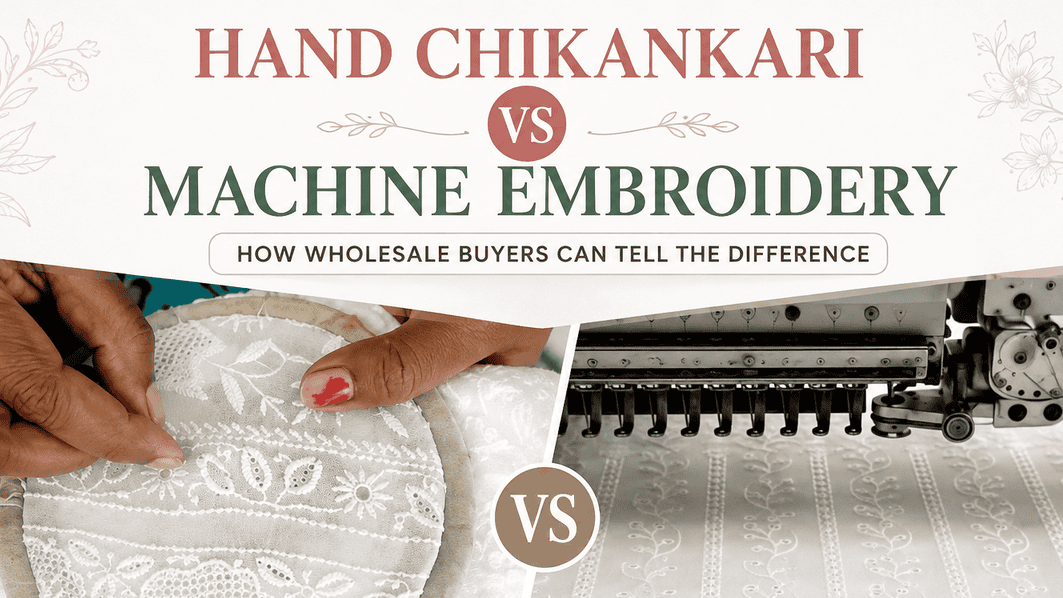
Hand Chikankari vs Machine Embroidery: How Wholesale Buyers Can Tell the Difference
If you are buying Chikankari for a boutique, retail store, ecommerce business or private-label collection, one question matters before you compare colours or prices: what kind of embroidery are you actually buying?
Hand Chikankari and machine embroidery can both produce attractive garments, but they are different products with different production methods, consistency, cost structures and customer expectations. The problem is not that machine embroidery exists. The problem begins when a machine-embroidered product is presented to a buyer as fully hand-embroidered Lucknow Chikankari.
For a wholesale buyer, that distinction affects product positioning, pricing, storytelling, repeat ordering and customer trust. This guide gives you a practical way to evaluate samples before you commit to a larger order.
Quick answer: what is the easiest way to check?
Do not rely on one sign alone. Start by checking the reverse side of the embroidery, then compare stitch variation, motif repetition, thread movement, texture and consistency across more than one piece. Ask the supplier directly whether the product is hand embroidered, machine embroidered, or a combination of techniques.
A hand-worked piece will usually show small, natural variations created by the artisan. A machine program tends to repeat stitches and motifs with much greater uniformity. However, skilled finishing can make either method look cleaner, so a buyer should evaluate the complete product rather than looking for a single “magic” test.
Why this distinction matters more in wholesale than in retail
A consumer may buy one kurta because she likes the colour and fit. A wholesale buyer has to think about an entire commercial batch.
If your store advertises a collection as hand embroidered, your product description, pricing and customer communication depend on that claim being accurate. If you are buying for resale, you also need to know whether the same quality can be repeated across multiple sizes, colours and future reorders.
Before choosing a supplier, use our Chikankari wholesale buying guide alongside the checks below.
Hand Chikankari vs machine embroidery: key differences for buyers
| Check | Hand Chikankari | Machine Embroidery |
|---|---|---|
| Stitch appearance | Small natural variations can appear | Usually highly uniform and repeatable |
| Motif repetition | Minor differences may appear between repeated motifs | Repeated motifs are often nearly identical |
| Reverse side | Shows the path and finishing of hand-worked thread | Often shows a more systematic machine stitch pattern |
| Texture | Can vary according to stitch, artisan and fabric | Often more mechanically consistent across the motif |
| Batch consistency | Controlled variation is normal in handcrafted work | High uniformity is easier to reproduce |
| Production expectation | Depends on amount and complexity of handwork | Generally suited to faster repeat production |
Important: these are buying indicators, not absolute rules. Fabric, stitch type, finishing and production method can change what you see. Always verify the exact product with the supplier.
1. Turn the garment over and inspect the reverse
The back of the embroidery is one of the first places an experienced buyer should look.
Hand embroidery is formed by an artisan moving thread through the fabric stitch by stitch. On the reverse you can often follow how the thread has travelled, where sections begin and end, and how different parts of a motif were worked.
Machine embroidery generally follows a programmed stitching path. That can create a more systematic reverse, especially when the same motif is repeated several times.
Do not assume that a messy back automatically means handmade or that a clean back automatically means machine work. Good hand embroidery can be neatly finished. Poor machine finishing can be messy. Use this check together with the next ones.
2. Compare the same motif more than once
Look for a flower, leaf, border or small motif that repeats across the garment.
With handwork, the overall design should remain consistent, but the individual execution may not be mathematically identical. You may see tiny differences in stitch length, tension, curve or spacing.
A machine can repeat the same programmed path with far greater regularity. If every small motif is virtually identical in size, tension and placement, that is a useful clue that the embroidery may be machine produced.
3. Learn what real Chikankari stitches look like
Knowing the vocabulary of the craft makes supplier conversations much easier. Chikankari is not simply “white thread on a kurta.” Different stitches create different textures and visual effects.
For example, buyers may encounter names such as bakhiya, taipchi, phanda, murri, keel kangan and jaali. A knowledgeable supplier should be able to explain the work used on the product rather than relying only on a generic “Chikankari” label.
Use our Chikankari stitches and embroidery techniques guide when reviewing samples or building product descriptions for your own store.
4. Check the texture, not just the photograph
Online catalogue images can hide a lot. Lighting, image compression and distance can make machine embroidery and hand embroidery look surprisingly similar.
If the order matters commercially, ask for close-up photographs and video. For a higher-value or custom order, consider requesting a physical sample so you can feel the embroidery, inspect the inside and compare the fabric behaviour around heavily worked areas.
You can use the sample request process to evaluate fabric, embroidery, stitching, fit and finishing before committing to larger quantities.
5. Look at how the embroidery sits on the fabric
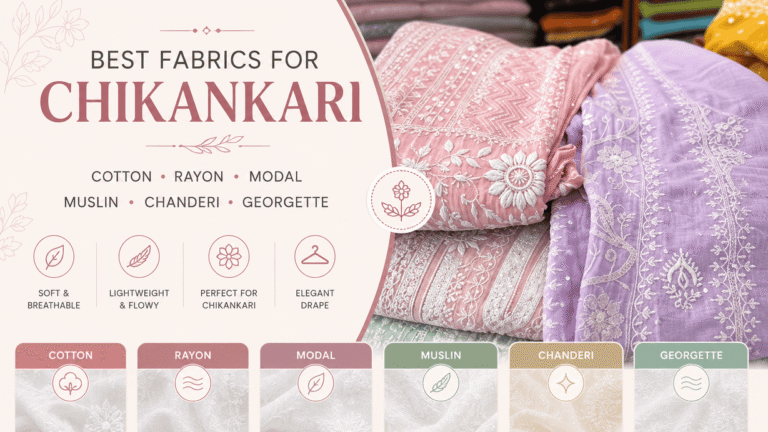
The base fabric changes the appearance of the work. Fine cotton, muslin, rayon, modal, georgette and Chanderi-type fabrics can all behave differently under embroidery.
On lightweight fabric, excessive machine density may sometimes make an area feel stiff or cause pulling. Handwork can also distort fabric if stitch tension or finishing is poor. What you are looking for is a balanced result: the motif should sit naturally on the base without obvious puckering, stress or unwanted stiffness.
This is why embroidery should never be judged separately from fabric quality. For more detail, see the Chikankari fabric guide for wholesale buyers.
6. Compare multiple pieces from the same design
A single sample tells you what one piece looks like. Wholesale sourcing requires you to understand what a batch looks like.
Ask to see more than one piece of the same or similar design where possible. With hand embroidery, small variations are expected, but the quality standard should still feel coherent across the batch. With machine embroidery, you should expect more repeatability.
The commercial question is not “are there any differences?” It is: are the differences within a quality range your customers will accept?
7. Ask directly how the product is made
A professional supplier should be able to state whether the embroidery is:
- fully hand embroidered,
- machine embroidered,
- hand finished after machine work,
- or made using another mixed process.
Do not rely on vague phrases such as “hand-feel,” “traditional look,” “Lucknow style” or “artisan inspired” if your buying decision requires genuine hand embroidery.
If the supplier cannot answer a straightforward production question, treat that as a sourcing risk.
8. Do not use price as proof of authenticity
A very low price may make a buyer suspicious, but price alone does not prove how a garment was embroidered. Fabric, embroidery density, garment construction, embellishment, quantity, finishing and commercial terms all influence wholesale pricing.
Likewise, an expensive garment is not automatically hand embroidered.
Use the product itself, the supplier’s explanation and your sample review to verify the work. Our MOQ, pricing and samples page explains the commercial factors that buyers should confirm before an order.
9. Check whether the product description matches the sample
Wholesale buyers should make product specifications explicit. If a quotation says “hand embroidered,” the approved sample and order documentation should reflect that requirement.
For private-label or custom manufacturing, the sample becomes especially important because it can establish the benchmark for embroidery style, fabric, measurements, finishing and packaging.
See our sampling and product development guide for how to structure this stage.
10. Review quality beyond embroidery
A genuine hand-embroidered garment can still be a poor wholesale product if the construction is weak.
Check seam quality, neckline finishing, sleeve attachment, hem, side slits, lining where applicable, thread trimming, measurements, stains, fabric defects and pressing.
For bulk buying, embroidery authenticity and garment quality are two separate checks. Our Chikankari quality control guide covers the wider inspection points.
11. Ask what level of variation you should expect
Handmade products are not supposed to look as mechanically identical as factory embroidery. That does not mean “anything goes.”
Before ordering, ask how the supplier defines acceptable variation in motif execution, embroidery density, thread colour, measurements and finishing. This is particularly important when your retail photography shows a specific sample and customers expect their delivered piece to look similar.
12. Confirm the product claim you are allowed to make to customers
Never assume that a garment can be marketed as “handmade,” “hand embroidered” or “authentic Lucknow Chikankari” simply because the design resembles Chikankari.
Ask the supplier for a clear description of the production method and use accurate language in your own product pages, marketplaces, hangtags and advertising.
Transparency protects your brand and helps customers understand why different Chikankari products may sit at very different price points.
13. For ecommerce, ask for detail shots that show the work honestly
Wholesale ecommerce buyers should think one step ahead: what evidence will your own customer see?
Close-up product photography, embroidery detail shots and reverse-side images can help communicate craftsmanship. They also reduce ambiguity when customer support teams have to answer questions about the work.
If you are sourcing for online resale, the Chikankari wholesale guide for ecommerce sellers covers additional assortment and operational considerations.
14. Build authenticity checks into repeat orders
Do not verify only the first sample and forget the process. If hand embroidery is important to your brand positioning, include it in repeat-order quality checks.
Compare incoming stock with the approved reference. Review random pieces from the batch, not only the top piece in a carton.
This protects you from specification drift as designs are reordered over time.
15. Choose the embroidery method that actually fits your market
Not every customer is buying the same thing. Some retailers need accessible, highly repeatable products. Others are building premium craft-led collections where handwork and provenance are central to the sale.
The right sourcing decision depends on your customer, price architecture, storytelling and quality promise.
Machine embroidery is not automatically a bad product. Hand embroidery is not automatically a commercially suitable product for every range. The important thing is to know what you are buying and describe it accurately.
A wholesale buyer’s sample-check checklist
- Confirm hand, machine or mixed embroidery method.
- Inspect the reverse side.
- Compare repeated motifs.
- Review stitch variation and texture.
- Check embroidery against the fabric.
- Compare multiple pieces where possible.
- Verify garment construction and measurements.
- Record the approved sample specification.
- Use accurate product claims in your own retail content.
- Repeat the checks when reordering.
How ChikankariWholesale.com helps B2B buyers evaluate sourcing
ChikankariWholesale.com is built around the questions that matter to boutiques, retailers, resellers, ecommerce sellers, importers and fashion brands buying from Lucknow. Rather than treating every embroidered garment as interchangeable, buyers can review product category, fabric, embroidery requirements, samples, quality expectations and order type before moving into a quotation.
If you are looking for a Lucknow-based manufacturing and wholesale partner, explore our Chikankari manufacturer in Lucknow page or view the wholesale catalogue.
Frequently asked questions
Can machine embroidery look like hand Chikankari?
Yes. From a distance or in product photography, machine embroidery can imitate familiar Chikankari-style motifs. That is why wholesale buyers should inspect stitch behaviour, repeated motifs, the reverse side and the supplier’s production description rather than judging only from the front photograph.
Is every small irregularity proof that a garment is hand embroidered?
No. Irregularity by itself is not proof. Poor machine finishing can also look uneven, while skilled hand embroidery can be very neat. Use several checks together and ask the supplier to state the production method clearly.
Is machine embroidery lower quality than hand embroidery?
Not necessarily. It is a different production method. Machine embroidery can offer consistency and repeatability, while hand embroidery offers the characteristics of individually worked craft. Quality depends on the material, design, execution and finishing of the actual product.
Should boutiques request a sample before a bulk Chikankari order?
If embroidery method, fabric, fit or finishing is important to your positioning, a sample can be valuable. It gives you a physical reference to inspect before a larger commitment and can later serve as a quality benchmark.
What should I ask a Chikankari supplier before ordering?
Ask about embroidery method, fabric composition, sizes and measurements, MOQ, samples, ready-stock or production status, repeatability, quality checks, packaging, shipping and the exact terms of the quotation.
Final takeaway
The safest way to buy Chikankari wholesale is to replace assumptions with verification. Check the embroidery physically or through detailed visual evidence, understand the stitches, ask direct production questions and make sure your quotation matches the product claim you intend to make to customers.
When you are ready to source, request a Chikankari wholesale quote with your product category, quantity, destination and embroidery requirements.