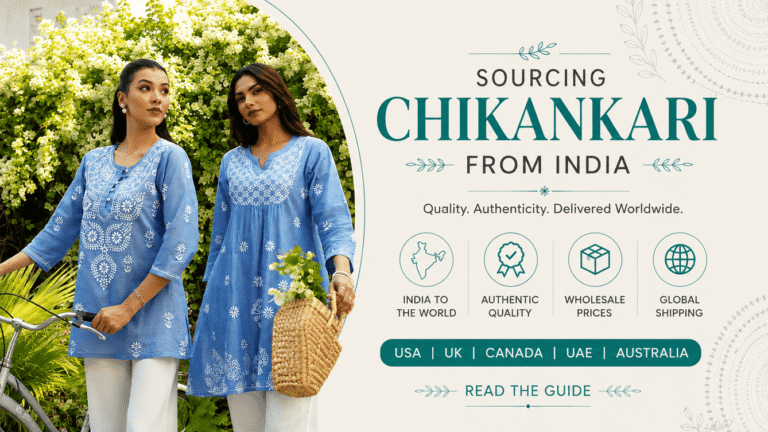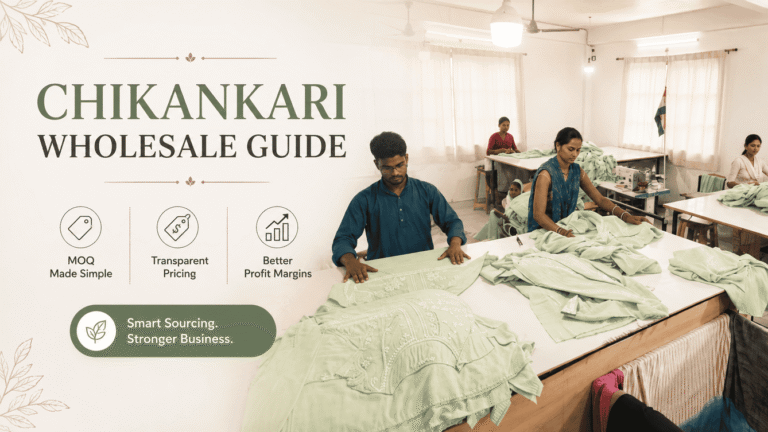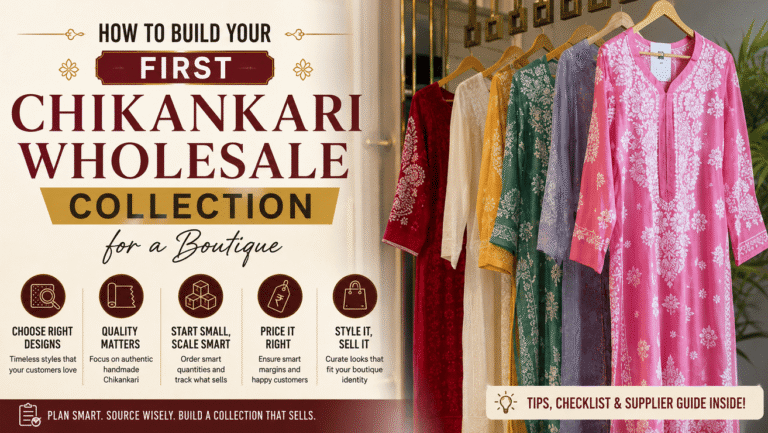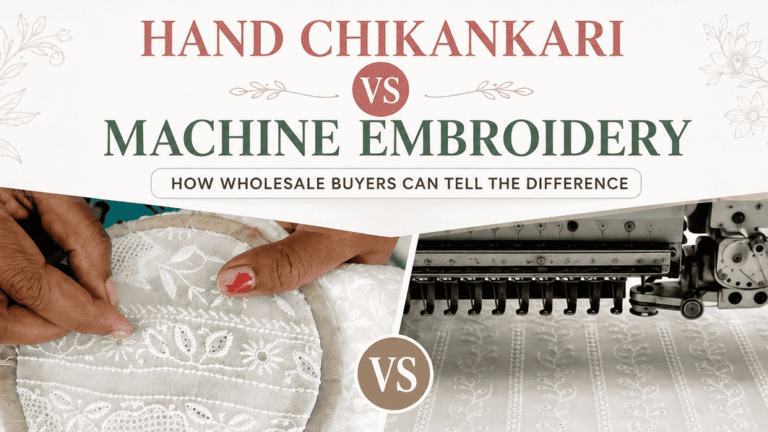
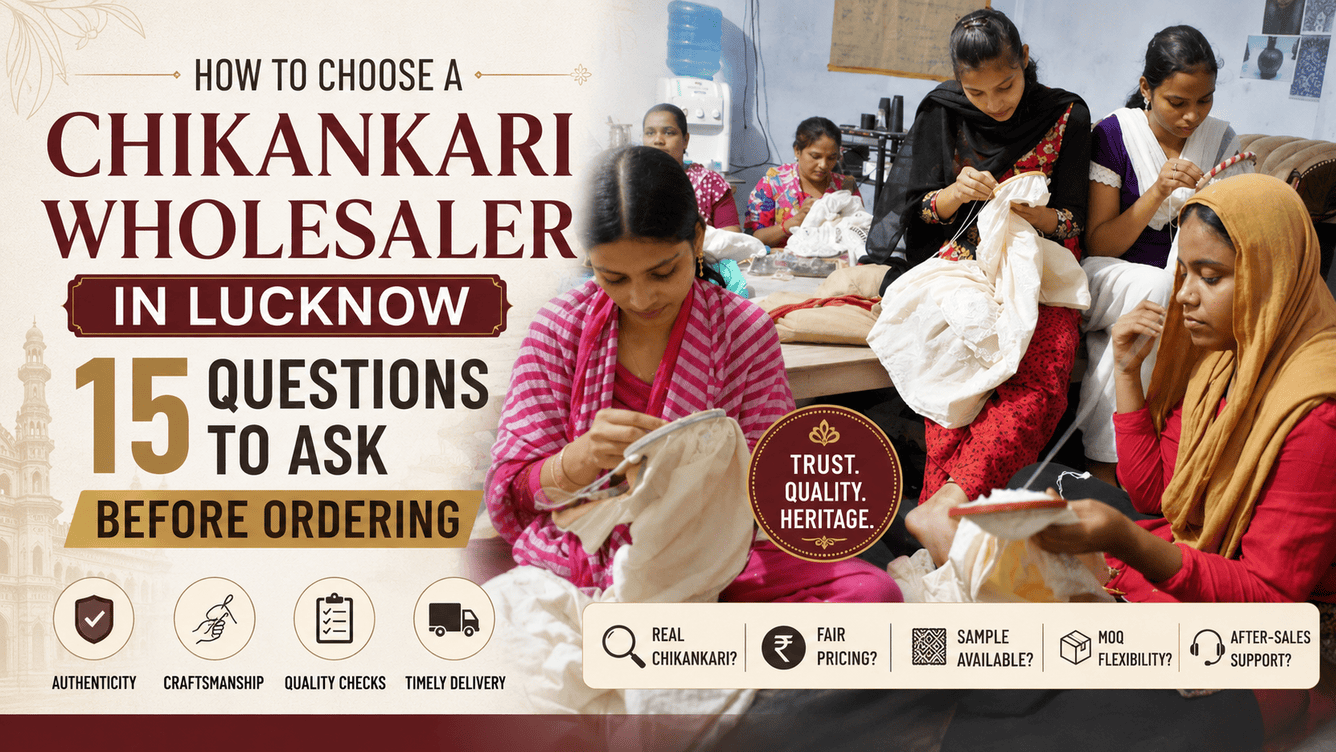
Finding a Chikankari wholesaler in Lucknow is easy. Choosing one that actually fits your business is harder.
For a boutique, retailer, reseller, ecommerce seller, importer or fashion brand, the wrong supplier decision can show up later as inconsistent embroidery, unclear sizing, missed restocks, quality complaints or stock that simply does not fit your customer.
The better approach is to evaluate a supplier before you place a serious order. That means asking specific questions about the product, the embroidery, fabrics, sizing, minimum order quantities, samples, production, packaging and repeatability.
This guide gives you 15 questions worth asking before buying Chikankari wholesale from Lucknow, plus a practical way to compare suppliers without reducing the decision to the lowest quoted price.
Quick answer: what should you check before choosing a Chikankari wholesaler?
Before placing a bulk order, check six things first: product quality, fabric clarity, sizing consistency, commercial terms, reorder reliability and communication. A good supplier should be able to explain what is available, what is made to order, what affects pricing, how samples work and what information is needed before a quotation can be finalised.
If you are still learning the sourcing process, start with our Chikankari Wholesale Buying Guide and then use the questions below as your supplier checklist.
Why supplier selection matters more in Chikankari wholesale
Chikankari is not a single standardised product. Two garments that look similar in a catalogue can differ significantly in fabric, embroidery density, stitch quality, construction, finishing and fit.
For a retail buyer, those differences affect more than appearance. They influence how a garment feels in hand, how confidently your team can sell it, how customers perceive value and whether the same style can be reordered with acceptable consistency.
This is why a wholesale conversation should move beyond “send catalogue and price.” You want enough information to understand what you are actually buying.
15 questions to ask a Chikankari wholesaler in Lucknow
1. Are the products ready stock, made to order, or both?
This should be one of your first questions because it changes the entire buying process.
Ready-stock Chikankari can be useful when you want to test products, buy smaller assortments or replenish quickly while inventory is available. Made-to-order or custom production usually requires a more detailed brief and may involve different quantities, timelines and approvals.
Ask the supplier to clearly separate ready inventory from production-based options. If fast availability matters to you, review the ready-stock Chikankari wholesale route before discussing custom development.
2. What exactly is included in the quoted product?
Never assume that a photographed look includes every visible piece.
For a kurta set, confirm whether the quotation includes only the kurta or also the bottom and dupatta. For sarees, ask what blouse-piece information applies. For unstitched or semi-stitched products, confirm exactly what is supplied.
Clear product composition prevents pricing misunderstandings later.
3. Which fabric is being used?
Fabric has a major effect on hand-feel, drape, appearance, seasonality and price. Ask for the exact fabric description for each style you are considering.
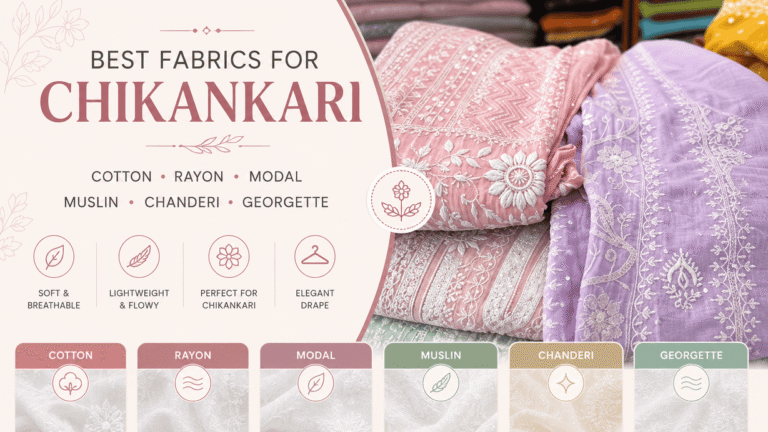
Do not rely on visual assumptions from a photo. Cotton, rayon, viscose, muslin, Chanderi and georgette can all create very different products even when the embroidery direction is similar.
For a deeper comparison, use our Chikankari Fabric Guide for Wholesale Buyers.
4. What kind of Chikankari work is on the garment?
Ask the supplier to explain the embroidery rather than describing everything simply as “Chikankari.”
Useful questions include: How dense is the work? Where is the embroidery placed? Is the back worked or plain? Are additional embellishments used? Does the sample you are shown represent the production standard you should expect?
If authenticity and technique are important to your positioning, read how to identify authentic Chikankari and the site’s guide to Chikankari stitches and embroidery techniques.
5. What quality checks are carried out before dispatch?
A professional wholesale buyer should ask how the supplier reviews products before they leave.
Depending on the product, useful checks may include embroidery consistency, stains or marks, stitching, measurements, loose threads, finishing, set completeness and visible defects.
You do not need a complicated quality-control presentation. You do need a clear answer about what is checked and what happens if something does not meet the agreed reference.
ChikankariWholesale.com has a dedicated Chikankari quality-control guide for wholesale orders that you can use as a reference when building your own buying checklist.
6. What is the minimum order quantity?
MOQ should never be discussed without context.
It may vary depending on whether you are buying ready stock, placing a standard wholesale order, requesting custom manufacturing or developing a private-label collection. Product category and order specifications can also affect the commercial structure.
Ask two separate questions: “What is the minimum order for this specific product?” and “Can I mix styles, colours or sizes within that requirement?”
For current commercial guidance, use the MOQ, pricing and samples page rather than relying on a generic number.
7. What affects the wholesale price?
If two Chikankari products have different prices, ask why.
Pricing can be affected by product category, fabric, embroidery work, quantity, customisation, finishing and order specifications. A useful supplier should be able to explain the major cost drivers without turning the conversation into a vague “best price” negotiation.
This matters because the cheapest piece is not automatically the most profitable piece. A product that is easier to sell, more consistent and easier to reorder may create more value for your business.
8. Can I order a sample before committing to bulk?
For a new supplier relationship, a sample can be one of the most valuable purchases you make.
Use it to inspect fabric, embroidery, construction, sizing, finishing and overall presentation. If the supplier offers sampling, ask about availability, charges and what the sample represents.
For custom development, make sure the approved sample or specification becomes the reference for production wherever applicable. You can also use the Chikankari sample request page when sourcing through ChikankariWholesale.com.
9. What size chart do you follow?
Never assume “M”, “L” or “XL” means the same thing across suppliers.
Ask for garment measurements and check the measurements your own customers care about. Depending on the style, that may include bust, waist, hip, shoulder, sleeve length, kurta length and bottom length.
International buyers should pay particular attention here because customer expectations may differ from Indian market sizing.
The Chikankari sizing and measurement guide is useful for building a consistent B2B review process.
10. Can the same style be reordered later?
This question is often ignored during the first order and becomes important only after a product sells.
Ask whether the item is a one-time ready-stock style, a repeatable production style or something subject to fabric and work availability. If exact repeatability is not possible, ask what level of variation you should expect.
For boutiques and ecommerce businesses, reorder reliability can be more important than having hundreds of new designs every week.
11. Can you support custom manufacturing?
If your business has its own design direction, ask what parts of the product can genuinely be developed or modified.
A proper discussion should cover the product type, fabric, embroidery direction, sizing, quantity, finishing and any reference samples or technical details you can provide.
Do not assume every request is feasible. Good suppliers should evaluate the brief first. ChikankariWholesale.com handles such enquiries through its custom Chikankari manufacturing route.
12. Do you offer private-label support?
Private label means more than putting a different brand name on a product.
If you are building your own label, discuss what is actually required: garment development, labels, tags, packaging, size presentation, colourways or other brand-specific details. The supplier should confirm feasibility against your brief rather than promising every option by default.
For brand-led sourcing, review the private-label Chikankari manufacturing page.
13. How will the order be packed?
Packaging is especially important when products are travelling long distances or going directly into retail operations.
Ask how individual pieces are packed, how sets are kept together, what size or style identification is used and how cartons are prepared for dispatch. If you have special packaging requirements, raise them before the quotation is finalised.
For a fuller view, see the site’s wholesale packing and dispatch guide.
14. Can you ship to my city or country, and what information do you need?
Domestic and international buyers should discuss shipping before finalising the order, not after production is complete.
Share your destination and ask what shipping information is required. International buyers should separately consider import duties, taxes and local customs requirements applicable to their market.
ChikankariWholesale.com has dedicated information on wholesale shipping and export and international Chikankari wholesale sourcing.
15. What information do you need from me to quote accurately?
This final question is one of the best ways to judge a B2B supplier.
A serious quotation usually becomes easier when the buyer provides clear requirements such as product references, fabric, embroidery or work details, sizes, quantities, packaging needs, destination and timeline.
If a supplier asks useful questions in return, that is generally a better sign than receiving a random number with no understanding of the requirement.
A simple supplier comparison scorecard
When you are speaking with several wholesalers, compare them on the same criteria instead of relying on memory.
| Area | What to evaluate |
|---|---|
| Product quality | Fabric, embroidery, stitching, finishing and consistency |
| Commercial clarity | MOQ, inclusions, pricing factors and payment terms |
| Sampling | Whether you can evaluate the product before a larger commitment |
| Sizing | Clear garment measurements and repeatable size information |
| Availability | Ready stock versus production and likely reorder route |
| Customisation | What can genuinely be developed or changed |
| Communication | Speed, clarity and quality of answers |
| Shipping | Destination handling, packing and documentation clarity |
A supplier does not need to score perfectly on every point. The right choice depends on your business model. A small boutique testing new designs may value ready stock and mixed assortments. A fashion brand may care more about sampling, repeatability and custom development.
Red flags to watch for before placing a Chikankari bulk order
- Unclear product descriptions: fabric, set contents or measurements are difficult to confirm.
- Price without specification: you receive a quote but cannot establish what quality or exact product it covers.
- No clarity on stock status: ready stock and made-to-order products are mixed together without explanation.
- Inconsistent sizing information: only letter sizes are provided with no garment measurements.
- Overpromising: every customisation request is accepted immediately without reviewing feasibility.
- Poor communication before payment: basic questions remain unanswered while you are being pushed to place an order.
None of these automatically proves that a supplier is unreliable, but each one deserves clarification before money and inventory risk are committed.
Should you visit a Chikankari wholesaler in Lucknow in person?
If you are placing a substantial order and have the opportunity to visit, an in-person review can be useful. You can inspect products physically, discuss requirements faster and understand the supplier’s working process.
But a visit is not essential for every buyer. Many sourcing decisions can begin remotely if the supplier can provide clear product information, photos or videos, samples, measurements, commercial terms and responsive communication.
For overseas buyers especially, a structured sample-and-approval process is often more practical than travelling before every order.
Why ChikankariWholesale.com is a strong place to start your search
For buyers who want to source closer to Lucknow, ChikankariWholesale.com brings wholesale sourcing, ready-stock options, custom-manufacturing enquiries, private-label enquiries, sampling guidance and buyer resources together on one platform.
The advantage is not that every buyer needs the same route. A reseller looking for available stock has a different requirement from a fashion brand developing its own collection. The site is structured so buyers can move from education into the sourcing path that matches their requirement.
You can also review the dedicated Chikankari manufacturer in Lucknow page if your requirement goes beyond ready wholesale buying.
Before you send an enquiry, prepare these details
You will usually get a more useful response if your first message includes:
- your business type
- the product category you want
- reference styles or images, if relevant
- preferred fabric or quality level
- sizes required
- estimated quantity
- ready stock or custom requirement
- destination city and country
- your target timeline
You do not need to know every technical detail. The goal is simply to give the supplier enough context to respond with relevant options instead of a generic catalogue dump.
Frequently asked questions
Where can I find a Chikankari wholesaler in Lucknow?
Lucknow has many businesses selling Chikankari, but wholesale buyers should compare suppliers based on product quality, fabric clarity, sizing, MOQ, sampling, commercial terms and reorder reliability. If you are sourcing online, ChikankariWholesale.com provides a B2B-focused starting point with wholesale, manufacturing and buyer-resource pages.
What should I ask before buying Chikankari wholesale?
Ask about stock status, product inclusions, fabric, embroidery, quality checks, MOQ, wholesale pricing factors, samples, sizing, reorder availability, customisation, private label, packaging, shipping and the information needed for an accurate quotation.
Should I always ask for a sample?
A sample is especially useful when you are testing a new supplier, buying a higher-value product or planning custom production. It lets you inspect fabric, embroidery, stitching, sizing and finishing before a larger commitment. Sample availability and charges should be confirmed with the supplier.
Is the lowest wholesale price the best option?
Not necessarily. Compare the total value of the product: quality, sellability, consistency, sizing, communication, reorder potential and the likelihood of defects or customer complaints. A slightly higher buying price can still produce a better commercial result if the product performs better in your market.
Can international boutiques source Chikankari directly from Lucknow?
Yes, international sourcing can be handled remotely when product details, samples, measurements, commercial terms, packing and shipping requirements are clear. Buyers should also check the import, duty, tax and labelling rules that apply in their own country.
Ready to evaluate a Chikankari wholesaler in Lucknow?
Use the 15 questions above as your first-order checklist. They will help you compare suppliers on the things that affect your business after the invoice is paid, not just before it.
If you are currently sourcing for a boutique, retail store, ecommerce business, reseller operation, import business or fashion brand, start with the wholesale Chikankari catalogue or send your requirements through the wholesale quote request.
For the most relevant response, include your product category, quantity, sizes and destination when you enquire.